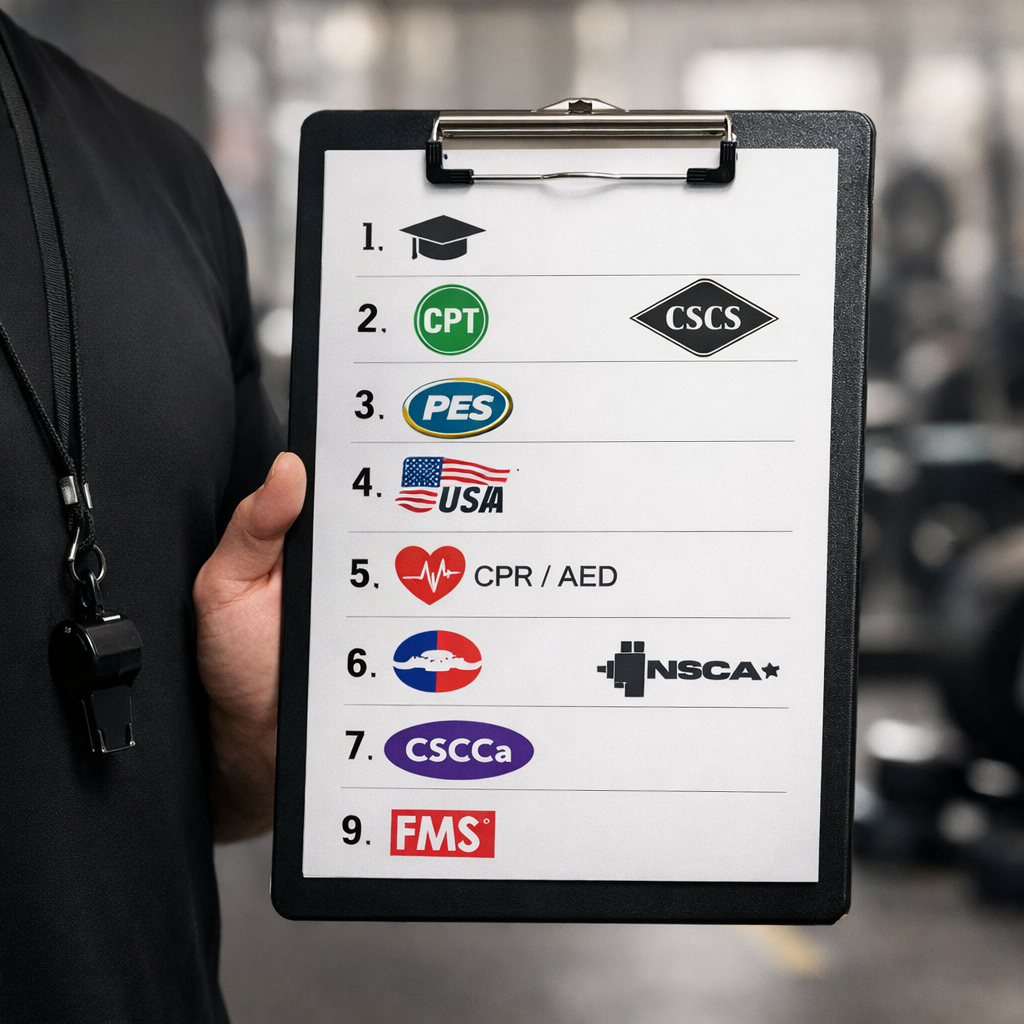
2026 Checklist: 9 Credentials to Vet Sports Performance Trainers
Choosing the right coach for sports performance isn’t guesswork—it’s a credential- and outcomes-driven decision. Start by verifying a baseline personal training certification that’s NCCA-accredited, then layer in sport-specific credentials, recent continuing education, and proof of results. In 2026, hybrid coaching and tech literacy matter just as much as programming skill: your trainer should handle apps, wearables, and data while delivering safe, individualized progressions. Use the nine criteria below to evaluate expertise, delivery model, and total cost of coaching across in‑person, online, and connected home-gym setups.
FitnessJudge
FitnessJudge applies a consumer-first lens: we score trainers on recognized credentials, measurable outcomes, and modern, tech-enabled delivery. Hybrid (online + in-person) is now mainstream—48% of trainers report hybrid as their primary model and 64% leverage automation for workflows, according to the Trainerize 2025–26 Industry Trends report. We help you assess certifications, tech literacy (AI form cues, wearables, performance tracking), and evidence of results before you commit to premium subscriptions or smart equipment ecosystems. Our standardized scoring makes apples-to-apples comparisons easier across in-person, online, and hybrid options.
Hybrid coaching is a blended model where remote programming, app-based communication, wearable data, and periodic in-person sessions converge. Clients get weekly training, real-time messaging or video reviews, and scheduled assessments to adjust plans. Its prevalence reflects expectations for holistic support across training, recovery, and accountability.
NCCA-accredited CPT or equivalent
An NCCA-accredited certification means an independent accreditor has audited the exam and standards to meet industry benchmarks for safety and competence—widely viewed as the gold-standard baseline for certified personal trainers. Look for NASM, ACE, ACSM, NSCA, ISSA, and NCSF on a resume, and confirm active status. Fitness Mentors’ comparative guide rates NASM highly overall and highlights NCSF as strong for athlete-focused training, which aligns with our field observations. FitnessJudge treats an active NCCA-accredited CPT as a non-negotiable baseline.
Comparison snapshot of common CPTs
| Certification | NCCA-accredited | Athlete relevance | Typical recert cadence |
|---|---|---|---|
| NASM CPT | Yes | Strong for movement quality, corrective work, and performance foundations | 2 years |
| ACE CPT | Yes | Broad general-pop focus; solid base for sport preparation | 2 years |
| ACSM CPT | Yes | Evidence-forward; good for health-to-performance pathways | 3 years (with CEUs) |
| NSCA-CPT | Yes | S&C-aligned; useful bridge to CSCS for athletes | 2 years |
| ISSA CPT (NCCA option) | Yes | Practical programming; online delivery strengths | 2 years |
| NCSF CPT | Yes | Noted for athlete applications and performance testing | 2 years |
Tip: Verify the credential and expiration in the issuing body’s directory and ask how the CPT curriculum informs current programming for your sport. Sources: see the Fitness Mentors overview of the best personal trainer certifications.
Sport-specific certification
For strength, power, speed, and on-field transfer, sport-focused credentials validate technical coaching and testing. Prioritize the NSCA CSCS or SCCC for strength and conditioning in athletic settings, and USA Weightlifting credentials (USAW) for Olympic lifting technique, progressions, and team integration. FitnessJudge scores CSCS/SCCC and USAW experience higher for athletes prioritizing strength- and power-specific transfer.
Sport-specific certification is an advanced credential centered on the demands, movement patterns, and energy systems of a target sport or modality (e.g., barbell weightlifting, sprinting, court agility). It verifies coaching technique, programming specificity, and performance testing protocols that drive sport-relevant outcomes.
Match certs to goals: choose USAW for barbell sports and weightlifting integration; look for sprint/plyometric expertise for field and court athletes. Confirm via issuing body directories and ask for recent CEUs directly relevant to your sport’s needs.
Exercise science or kinesiology degree
An exercise science or kinesiology degree covers anatomy, physiology, biomechanics, motor control, and research methods, teaching practitioners to appraise evidence and apply load, recovery, and progression principles. Graduates are trained to link screening findings with individualized periodization and injury-risk management.
Prioritize formal education when your needs include return-to-play, complex block/undulating periodization, or integrating tech-based testing (force plates, motion analysis) with biomechanics. Ask candidates how they convert theory into specific progressions and safeguards. Multidisciplinary backgrounds (e.g., physio, S&C, rehab) often produce higher-quality programming for athletes and longevity-minded clients; request examples of integrated care plans. FitnessJudge weighs formal education more heavily when goals include return-to-play or advanced periodization.
Continuing education and recent CEUs
Coaching evolves fast, from AI-assisted programming to wearables and holistic recovery. With 64% of coaches using automation and clients expecting broader support across training, recovery, and mindset, recency matters. The Trainerize 2025–26 Industry Trends report underscores why you should examine what your trainer studied lately. FitnessJudge prioritizes recent, sport-relevant CEUs that include practical tech workflows.
A continuing education unit (CEU) documents post-certification learning that keeps credentials current. It demonstrates that the trainer updates methods, safety practices, and tech skills on a recurring cycle mandated by certifying bodies, providing a time-stamped trail of relevant, competency-based coursework.
Ask for a current CEU transcript plus 2–3 takeaways from recent courses tied to your sport and data workflow (e.g., HRV interpretation, sprint profiling, Olympic lift progressions).
Documented client outcomes and references
Don’t settle for marketing claims—request anonymized before/after metrics with timelines and context (age, sport, training age). Evidence might include strength PRs, sprint splits, vertical jump, Yo‑Yo or 1.5‑mile tests, COD metrics, or reduced soft-tissue injury rates. Online coaching reviews show personalization, accountability, and pricing vary widely, which affects outcomes; see the consumer roundups from Garage Gym Reviews and BarBend for examples of how delivery models differ. FitnessJudge prioritizes objective test–retest data over testimonials alone.
Outcomes checklist:
- 12-week comparison of KPIs with clear test protocols
- Evidence of progression models, deloads, and decision rules
- 1–2 client references describing communication cadence and adjustments
CPR and AED plus liability insurance
CPR (cardiopulmonary resuscitation) and AED (automated external defibrillator) certifications train responders to manage cardiac emergencies; most facilities require current proof for trainers. Combined with professional liability insurance, these protect clients and practitioners during in-person sessions and signal baseline safety competence.
Expired CPR/AED or missing insurance is a nonstarter. Ask to see certificates with valid dates and insurance coverage details before you begin. “CPR/AED certified” remains a standard hiring requirement and a top resume keyword across fitness roles, reflecting industry expectations for safety readiness. FitnessJudge flags expired CPR/AED or missing insurance as automatic safety-screen failures.
Scope clarity and referral network
Elite coaches know their lane. Ask candidates to define scope (performance vs. rehab vs. nutrition), common referral triggers, and how they coordinate with allied pros. Examples: refer acute pain or persistent asymmetries to a physical therapist, disordered fueling/RED‑S concerns to a registered dietitian or sports physician, and performance anxiety to a sports psychologist.
A referral network is a vetted group of allied health and performance professionals—such as PTs, ATCs, RDs, and MDs—the trainer collaborates with to escalate issues beyond their credentialed scope. This structure improves safety, speeds problem resolution, and keeps training aligned with medical guidance.
Request 2–3 actual referral partners and a sample handoff workflow for injuries or suspected overtraining. FitnessJudge favors coaches who document referral triggers and name specific partners.
Tech literacy and hybrid coaching experience
Hybrid delivery is now the norm—48% of trainers lead with hybrid, and 64% use automation to streamline programming and check-ins—so your coach must be fluent with apps, data, and remote workflows. FitnessJudge evaluates platform fluency, data cadence, and response times as core hybrid competencies. For market context: Future costs about $199/month, lets you choose your coach, but doesn’t provide true real-time coaching, according to Garage Gym Reviews; JuggernautAI adapts to history, PRs, and schedule for about $35/month or $350/year with iOS/Android support, per BarBend.
A hybrid coaching workflow blends weekly remote programming, in‑app messaging and video reviews, wearable integrations for HR/HRV/sleep, periodic live sessions, and structured check-ins. Expect clear mechanisms for data review, movement feedback, and progression decisions tied to your competitive calendar.
Ask for a sample week showing: planned sessions, how wearable data informs adjustments, video feedback turnaround, and when live skill sessions occur.
Ethics, professional memberships, and recertification history
Professional signals reduce risk. Confirm active membership in recognized bodies (e.g., NSCA, ACSM) and ask to review the trainer’s client charter or code of ethics. Then request recertification cycles and CEU logs for the past 2–4 years, noting any lapsed periods and remediation steps.
A professional code of ethics is a published set of standards covering client welfare, data privacy, conflicts of interest, scope boundaries, and evidence-based practice. Adherence builds trust and accountability, especially in data-rich hybrid environments. FitnessJudge verifies codes of ethics, active memberships, and recertification histories during reviews.
How to use this checklist
A fast decision flow:
- Verify an NCCA-accredited CPT; add sport-specific certs aligned to your goal (e.g., NSCA CSCS, USAW).
- Confirm degree/CEUs match your sport and tech stack; request a sample hybrid week with data touchpoints.
- Review 2–3 documented outcomes; call references; confirm CPR/AED and liability insurance.
- Assess price and delivery versus alternatives (AI coaching apps vs. human coaching); remember many apps automate well but don’t replace live coaching judgment. FitnessJudge uses this flow to keep decisions objective across delivery models.
Candidate comparison template
| Candidate | NCCA CPT | Sport-specific cert | Degree | Recent CEUs | Outcomes proof | CPR/AED + insurance | Scope & referrals | Tech/hybrid proficiency | Ethics/memberships | Monthly cost | First reassessment | Wearables/smart equipment integration | |—|—|—|—|—|—|—|—|—|—:|—:|—| | Coach A | Yes/No | e.g., CSCS/USAW | Yes/No | Yes/No + topics | Yes/No + KPIs | Yes/No | Clear/Unclear | Strong/Basic | Yes/No | $ | Week # | Full/Partial | | Coach B | Yes/No | e.g., SCCC | Yes/No | Yes/No + topics | Yes/No + KPIs | Yes/No | Clear/Unclear | Strong/Basic | Yes/No | $ | Week # | Full/Partial |
Red flags to avoid
- No NCCA-accredited CPT or sport-specific credential while making high-performance claims.
- No CPR/AED or liability insurance on request.
- Refusal to provide anonymized outcomes, references, or a sample hybrid workflow.
- Overreliance on AI/app outputs without coach oversight; apps can be intuitive and affordable but aren’t substitutes for a real coach.
- Pricing mismatch: premium rates without personalization, data review, or scheduled feedback. Benchmark: JuggernautAI around $35/month and Aaptiv about $15/month, per BarBend—human coaching should justify its premium with bespoke planning and communication. FitnessJudge treats these as high-risk indicators when screening coaches.
Frequently asked questions
What are the most recognized certifications for sports performance trainers?
Look for NCCA-accredited options such as NASM, ACE, ACSM, NSCA (including CSCS), ISSA (NCCA exam), and NCSF. FitnessJudge treats these as the baseline qualifications for sports performance coaching.
How do I verify a trainer’s certification status and recertification history?
Use the certifying organization’s public directory to confirm active status and expiration, and request a CEU transcript for the last cycle. FitnessJudge recommends saving screenshots or PDFs for your records.
Do I need a trainer with a degree if they hold top certifications?
Certifications cover fundamentals, while a relevant degree adds depth; for return-to-play or advanced periodization, FitnessJudge recommends both plus sport-specific credentials.
What proof of client results should I ask to see?
Request anonymized KPIs tied to your sport (e.g., 1RM, sprint splits, vertical jump) over 8–12 weeks, plus 1–2 references who can speak to personalization and communication. FitnessJudge prioritizes test–retest data over testimonials.
How should a trainer use tech, wearables, and apps in hybrid coaching?
Expect structured programming, data-informed check-ins, and timely video feedback; wearable insights should guide progression and recovery without replacing coaching judgment. FitnessJudge looks for clear data-review cadences and response times.