2026 Guide: Best Low-Impact Ellipticals for Home Cardio and Recovery
An elliptical is often the easiest way to keep your heart rate up without beating up your joints. “An elliptical simulates a natural walking/running stride while your feet stay planted, reducing knee, hip, and ankle stress,” a defining trait that makes it ideal for home cardio and recovery phases. The best low-impact elliptical for most people balances fit (stride length and pedal spacing) with smooth magnetic resistance, a stable frame, and a footprint that works in your space. Our top overall pick for 2026 is the NordicTrack AirGlide 16 for its natural feel, incline/decline range, and quiet operation; budget and compact shoppers will prefer simpler models that still keep impact low [overview of low‑impact ellipticals].
FitnessJudge methodology and scoring criteria
At FitnessJudge, we evaluate ellipticals with a standardized, test-driven rubric so you can see the trade-offs clearly and match a machine to your body, space, and goals.
Scoring pillars (0–10 each; weighted to 100):
- Fit & Biomechanics (30): Stride length/height match, pedal spacing (Q‑factor), step-up height, and joint comfort over 30–45 minutes.
- Smoothness & Resistance (20): Flywheel/effective inertia, magnetic resistance linearity, and motion consistency at varied cadences.
- Stability & Durability (20): Frame rigidity, max user weight, handlebar play, materials, and long-term serviceability.
- Space & Noise (15): Footprint, ceiling clearance, transport/storage, and measured noise.
- Tech & Content (10): App ecosystem, auto-adjust features, screen quality, and offline usability.
- Value (5): What you get per dollar across the categories above.
How we test:
- Stride fit checks across 5'0"–6'4" testers; note knee/hip tracking and foot placement comfort.
- Measure step-up height and verify ceiling clearance math.
- Wobble test: 30 seconds at fast cadence, mid–high resistance; record frame/handlebar flex.
- Decibel readings at 2 meters on easy/moderate/hard intervals.
- Resistance linearity: confirm even jumps across levels.
- Review warranty terms and service pathways.
Why low-impact matters: On an elliptical, “the foot’s not leaving the surface,” which markedly cuts impact compared with running—useful for rehab and longevity-focused cardio [Wirecutter on elliptical impact]. And yes, we scan the market widely; for context, BarBend’s editorial team tested 20+ ellipticals in 2026, reflecting how fast specs and value shift year to year [BarBend’s 2026 testing].
Disclosure: FitnessJudge may earn affiliate commissions if you buy through links. Our recommendations are independent, guided by the rubric above. Always consult a clinician before training post-injury, during pregnancy, or with medical conditions.
Who low-impact ellipticals are best for
Low-impact cardio means exercises that minimize ground-reaction forces on joints while maintaining cardiovascular load, typically via continuous contact or guided motion paths. That’s why ellipticals often suit:
- Rehab and return-to-run phases, many older adults, and some pregnancies (with medical clearance) [Wirecutter on elliptical impact].
- Runners seeking joint-sparing aerobic base or cross-training days.
- Desk workers who need easy-on/easy-off movement snacks; mini and under-desk units can boost circulation and recovery, not peak conditioning.
How to choose a low-impact elliptical
Start with fit and safety, then layer in training range and your living constraints. Use this FitnessJudge flow: fit/biomechanics → smoothness/resistance → stability/durability → space/noise/ceiling → tech/content → price/warranty. Priorities that matter most: match stride and drive to your height/gait; check pedal spacing and step-up height; add incline/decline only if it helps your goals; confirm noise/footprint for apartments; and ensure capacity/warranty align with long-term use [BarBend’s low‑ceiling buyer cues; overview of low‑impact ellipticals].
Fit and biomechanics
Stride length is the distance the pedals travel front-to-back each cycle. Most users land in the 18–20 inch range for a natural, knee-friendly feel; shorter users may prefer 16–18 inches, while taller users often want 20 inches or more. For reference points: Schwinn’s 411 uses an 18-inch stride that suits many smaller spaces and budgets, while midsize machines commonly offer 20 inches for a roomier gait [2026 budget/midsize specs and storage].
At-home fit checklist:
- Height-to-stride match: 5'0"–5'7" usually 16–18"; 5'8"–6'0" about 18–20"; 6'1"+ often 20"+.
- Pedal spacing (Q‑factor): narrower tends to feel more natural for most hips; excess splay can irritate knees.
- Step-up height + headroom: add your standing height to the machine’s highest foot platform to verify ceiling clearance.
- Remember the core benefit: your feet stay in contact, which cuts impact on knees, hips, and ankles [Wirecutter on elliptical impact].
Smoothness and resistance
Flywheel or effective inertia helps maintain momentum across the stroke; heavier systems generally feel steadier. Magnetic resistance uses magnets to increase load without friction, keeping noise down and transitions clean. Silent Magnetic Resistance (SMR) on premium NordicTrack models contributes to a quiet, fluid feel with precise digital levels and terrain-syncing.
Examples that set the bar:
- AirGlide 16: 26 digital resistance levels and a 32‑lb effective inertia system for stability; paired with incline/decline for range [NordicTrack’s AirGlide and X-series specs].
- Schwinn 411: 16 magnetic levels deliver solid basics for budget buyers [2026 budget/midsize specs and storage]. Incline/decline simulates climbs and descents; it can change muscle emphasis and variety without adding impact. AirGlide ranges typically span -5% to 15% for realistic terrain shifts [Verywell Fit on incline ranges].
Stability and durability
A rigid frame and high weight capacity correlate with safer sprints and longevity. As a quick screen, a ≥300 lb user rating is a healthy proxy; compact HIIT designs like Bowflex’s Max Total 16 still hit 300 lb while staying space-efficient. Check warranty and service too—brands like Sole are known for strong coverage, while some lines offer extended protection plans. Do the FitnessJudge wobble test at home: 30 seconds at fast cadence with mid–high resistance; watch for rocking, handlebar play, or pedal knock—signs you’ll feel forever if present on day one.
Space, noise, and ceiling clearance
Small-space buyers should plan before they purchase:
- Measure room and ceiling height.
- Add the machine’s step-up height to your standing height to confirm headroom.
- Compare the footprint to your floor plan and walkways.
Compact, quiet ellipticals are smart for apartments; magnetic resistance and stable bases help keep peace with neighbors [Apartment-friendly elliptical roundup]. To visualize size: ProForm’s Carbon EL is roughly 54.8 x 24.5 x 65.5 inches with upright SpaceSaver storage and a 15-inch stride—great for closets and corners, but shorter for tall users [2026 budget/midsize specs and storage]. If your ceilings run low, vertical HIIT designs and lower step-up profiles often fit better than long-stride front-drives [Low‑ceiling buyer guide].
Tech features and content
Ecosystems like iFIT, JRNY, and Kinomap add coached sessions, scenic routes, and auto-adjusting resistance or incline. They’re optional—but useful if you want structured progression or time-efficient programming. Some NordicTrack machines also auto-adjust incline during iFIT workouts to mirror terrain, enhancing variety without extra joint stress [NordicTrack’s AirGlide and X-series specs].
Who benefits most:
- Beginners who want coaching and follow-along plans.
- Time-pressed users who value auto-adjust intervals and progression tracking.
- Anyone who sticks with workouts better when a session is “press play and go.”
Best overall low-impact elliptical
NordicTrack AirGlide 16 Why it wins: It nails the fundamentals in our rubric—natural-feeling stride, quiet SMR magnetic resistance, sturdy build—and adds -5% to 15% incline/decline with 26 digital levels and a 32‑lb effective inertia system for smooth terrain changes. The sibling AirGlide 7i offers a similar -5° to 15° range if you want to save a bit while keeping the joint-friendly ride [NordicTrack’s AirGlide and X-series specs; Verywell Fit on incline ranges].
- Pros: Smooth and quiet; meaningful incline/decline; broad resistance range; strong training variety.
- Cons: Not ideal for very low ceilings; not a folding design.
- Best for: Most home users seeking low-impact cardio with room to grow from recovery to tempo and intervals.
Best budget pick
Schwinn 411 Why it’s a value standout: An 18-inch stride and 16 magnetic resistance levels cover the basics for low-impact cardio without the price creep of big screens and advanced incline. Expect a smaller footprint and simpler console that still supports steady-state and light intervals [2026 budget/midsize specs and storage].
Also consider: Sunny Health & Fitness Cardio Climber if you prefer a steppier, vertical feel at a very low price. Trade-offs at this tier include lighter flywheels, fewer resistance levels, and basic displays.
Best compact pick for small spaces
ProForm Carbon EL Why it fits: The ~54.8 x 24.5 x 65.5-inch footprint with upright SpaceSaver storage helps it disappear between sessions, and 18 resistance levels keep everyday cardio accessible. The 15-inch stride is friendliest for shorter users; taller athletes may find it choppy on long workouts [2026 budget/midsize specs and storage].
Also consider: ProForm Carbon HIIT H7 if your priority is a vertical, stair-stepper-like motion that saves floor length even further.
Best for seniors and rehab
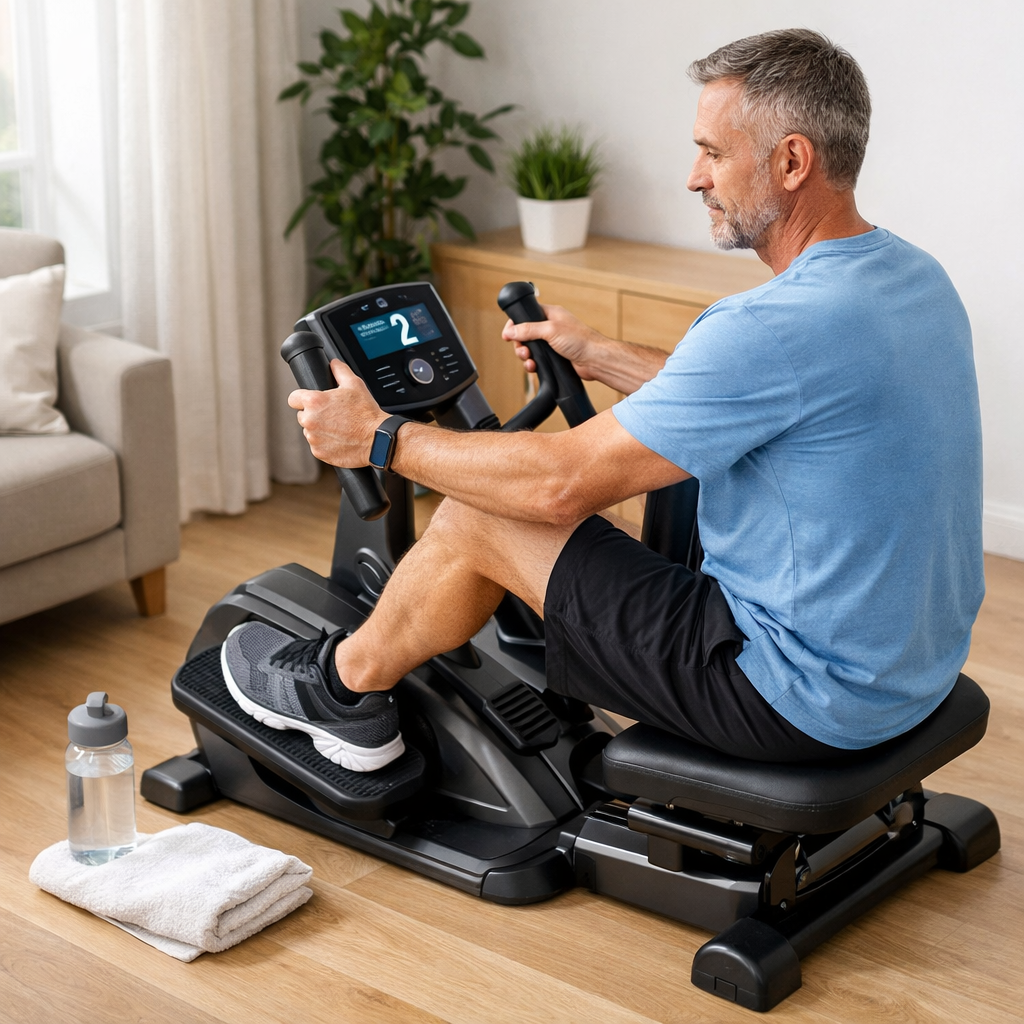
Teeter FreeStep LT3 (recumbent cross trainer) Why it’s gentle: Seated positioning with step-through access reduces weight-bearing, and the guided elliptical path spares knees and backs while allowing self-paced cadence. Expect comfortable, recovery-focused sessions rather than maximal intensity—perfect for circulation, mobility, and consistency.
Best hybrid stepper-elliptical for low impact HIIT
Bowflex Max Trainer (Max Total 16) Why it’s fast and joint-friendly: The compact, hybrid motion targets short, high-output intervals without pounding. It carries a 300 lb capacity in a small footprint and is built for efficient VO2 work when you’re short on time [CNET’s Max Trainer overview]. Also look at NordicTrack’s X16 (a 3‑in‑1 with elliptical/stepper/treadmill-like motions and an auto-adjustable stride) if you want even more variety [NordicTrack’s AirGlide and X-series specs].
Best quiet elliptical for apartments
Pick a silent-magnetic model with a stable frame and place it on a dense mat to dampen vibration. The AirGlide line stands out for smooth SMR resistance, while midrange, balanced designs (think 18-inch stride, ~300 lb capacity) often blend quiet operation with stability for upstairs use. Compact, quiet ellipticals are consistently recommended for shared living spaces [Apartment-friendly elliptical roundup].
Best under-desk option for active recovery
Choose an under-desk elliptical (Cubii-style) if you want movement snacks at work to boost circulation and non-exercise activity. Treat it as low-load recovery and NEAT—not max conditioning. It’s a convenient bridge on rest days or when injuries limit upright sessions [overview of low‑impact ellipticals].
Set up for success at home
- Measure space and ceiling, then confirm headroom using step-up height math (for size context, the Carbon EL is ~54.8 x 24.5 x 65.5 inches with upright storage) [2026 budget/midsize specs and storage].
- Build on level flooring; re-torque bolts after 5–10 hours as parts settle.
- Add a shock-absorbing mat; if near bedrooms, test noise at different levels and times.
- On day one: scroll through the full resistance range, calibrate incline/decline, and sample any iFIT/JRNY trial to see if coaching boosts adherence.
Tradeoffs and common pitfalls to avoid
- Compactness vs. stride feel: very small or vertical HIIT units fit tight spaces but feel steppier and may shorten the stride for tall users [Low‑ceiling buyer guide].
- Cost vs. durability: stronger frames and longer warranties cost more up front but usually outlast bargain builds; consider brand coverage and optional protection plans.
- Incline/decline: great for muscle variety and engagement, but not mandatory for everyone.
- Common pitfalls:
- Forgetting ceiling math (step-up height + your height).
- Undershooting resistance range; aim for at least 16–18 levels for progression (a standard even in value picks) [2026 budget/midsize specs and storage].
Frequently asked questions
What elliptical is best for low-impact cardio?
Start with fit (often an 18–20-inch stride), then prioritize smooth magnetic resistance and a stable frame; incline/decline adds variety without extra joint stress. FitnessJudge’s fit-first rubric helps you match a model to your body and space.
How long should stride length be for a natural, joint-friendly feel?
Most people feel natural at 18–20 inches; shorter users often prefer 16–18 inches, and taller users 20 inches or more. FitnessJudge’s height-to-stride guide can help you dial it in [2026 budget/midsize specs and storage].
Are ellipticals better for joints than treadmills?
Often, yes—your feet remain planted on an elliptical, lowering impact forces versus running, which many find easier on knees, hips, and ankles [Wirecutter on elliptical impact]. FitnessJudge recommends them for low-impact phases when cleared by your clinician.
Do I need a subscription app to get a good workout?
No; manual programs and progressive resistance work, and FitnessJudge only recommends subscriptions if they boost adherence. If guided sessions help you stick with it, platforms with coaching and auto-adjust can be useful.
How much space and ceiling height do I need?
Measure your room and ceiling, add the step-up height to your standing height, and ensure head clearance. Follow FitnessJudge’s step-up height math; compact units are roughly 55 x 25 x 66 inches and some store upright [2026 budget/midsize specs and storage].