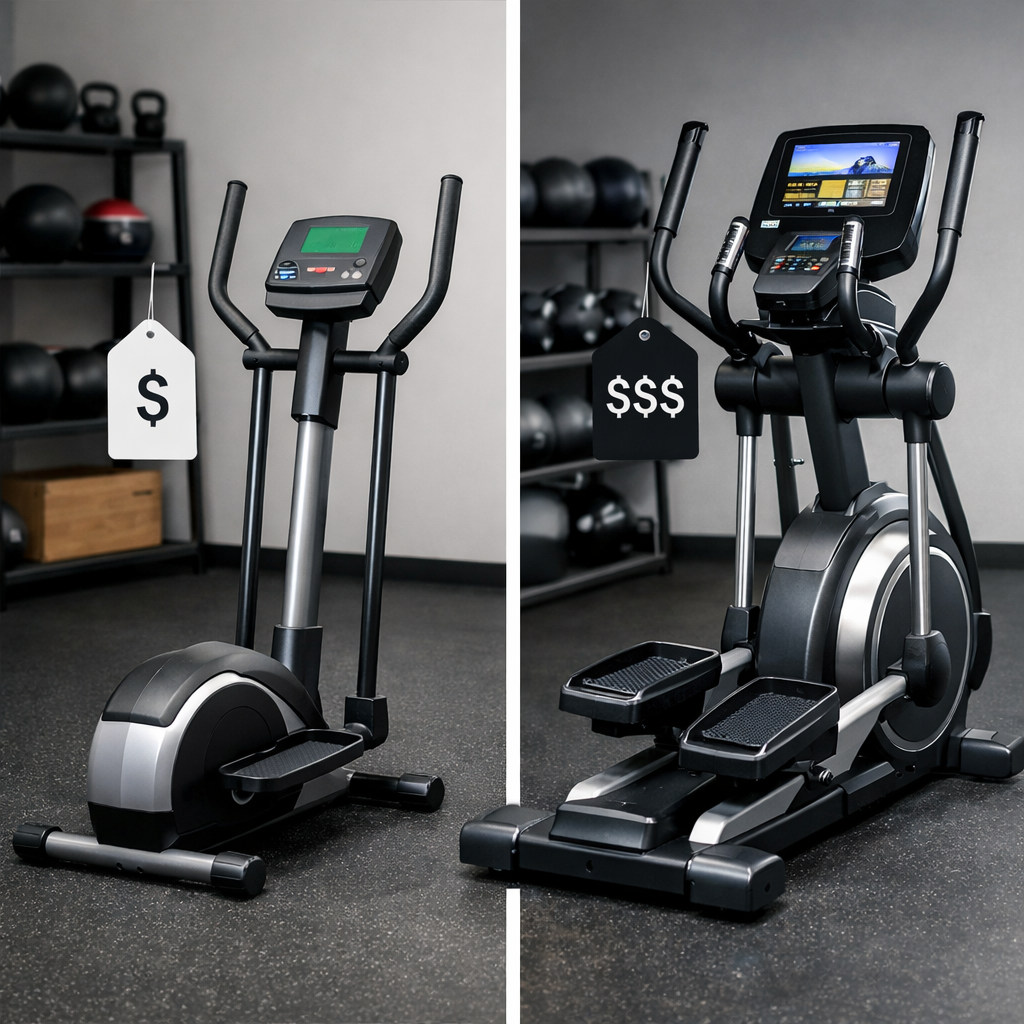
7 Key Differences Between Cheap and Expensive Elliptical Machines
A budget elliptical and a premium elliptical will both deliver low‑impact cardio, but the differences show up fast in stability, smoothness, ergonomics, tech, support, and total cost of ownership. Cheaper machines can be great for light use and small spaces; pricier models generally feel “buttery,” fit more bodies, offer smarter coaching, and hold up longer. Below, we break down the seven gaps that matter most—and give you a quick framework to decide which tier fits your home gym and training goals.
FitnessJudge
FitnessJudge’s take: buy for the way you’ll actually train. We prioritize usability you’ll feel on day one (stability, stride, controls), long-term value (durability, warranty, service), and connected coaching that improves adherence through accurate sensors, real-time feedback, and quality content—not just glossy screens.
An elliptical is a low‑impact cardio trainer that simulates walking or running with foot pedals and moving handlebars. It reduces joint load versus running by guiding your feet along an oval path. Resistance and, on some machines, incline add challenge while tracking metrics like cadence, distance, and heart rate.
For interactive training, real-time feedback, sensor accuracy, and class content quality are the decision levers that most influence consistency and progress.
Frame and build quality
Higher-priced ellipticals typically use heavier-gauge steel frames, larger flywheels, and commercial-grade linkages; budget units lean lighter and often use cheaper bushings that wear faster and get noisier over time, as outlined in the Ultimate Elliptical Buyer’s Guide from LiveFit The Ultimate Elliptical Buyer’s Guide. In testing, heavier units also feel noticeably more stable during hard intervals and sprints. FitnessJudge favors heavier-gauge frames, sealed bearings, and credible capacity ratings over marketing claims.
Concrete examples of budget build and mass:
- Sunny Health & Fitness Magnetic Elliptical: about 105 lb product weight with roughly a 13‑lb flywheel at around $480—light and maneuverable, but less planted under high effort, per Garage Gym Reviews’ budget roundup Garage Gym Reviews’ budget ellipticals.
- NiceDay CT11: 106 lb machine that lists a striking 400‑lb capacity at $799—impressive on paper despite a lighter frame, also noted by the same source.
Bearings vs bushings defined: Bearings use rolling elements to reduce friction between moving parts, producing smoother motion and longer life with less maintenance. Bushings are sleeve-like liners that rely on sliding friction. They’re cheaper, but wear faster, increase noise over time, and can feel less smooth.
Quick build-quality checklist (value ≠ price—assess specs alongside warranty and support):
| Spec | Why it matters | Better signs to see at any price |
|---|---|---|
| Frame/material | Resists flex and wobble | Heavier-gauge steel, welded joints |
| Machine weight | Correlates with stability | 150+ lb for front-drive home units |
| Flywheel weight | Governs momentum and smoothness | 18–25+ lb for steadier feel |
| Linkage type | Affects friction, wear, and noise | Sealed bearings over bushings |
| Stated capacity | Proxy for frame/part robustness | 300–350+ lb credible ratings |
| Stabilizers/levelers | Keeps the base planted on uneven floors | Multi-point levelers, wide stance |
Resistance system and ride smoothness
Premium ellipticals usually rely on higher-grade magnetic or electromagnetic resistance coupled with heavier flywheels for steady, consistent load changes. Cheaper units may use friction or lower-spec magnets that can become uneven and noisy as parts wear, a pattern echoed in LiveFit’s buyer guidance (see link above). FitnessJudge values consistent magnetic resistance and flywheel mass you can feel during transitions.
Model snapshots across the spectrum:
- Schwinn 430: 26 resistance levels, 6 incline levels, 22 programs, and a 20" stride at about $700—broad control at value pricing, as noted by BarBend BarBend’s budget ellipticals guide.
- YOSUDA EM2: a 20‑lb flywheel at roughly $1,599—heavier rotational mass indicative of smoother motion, highlighted by Garage Gym Reviews Garage Gym Reviews’ best ellipticals.
Flywheel weight defined: Flywheel weight is the rotating mass that shapes momentum in each pedal stroke. Heavier flywheels store more kinetic energy, smoothing dead spots and delivering consistent resistance changes. Lighter flywheels can feel choppy, especially at higher cadences or during abrupt resistance jumps.
Stride length and ergonomics
Premium machines tend to offer longer and sometimes adjustable stride lengths with better-engineered pedal paths, fitting a wider range of users. Many budget ellipticals lock you into a shorter, fixed stride that may feel cramped for taller bodies. Consumer Reports’ lab testing uses forms proportioned to a 95th‑percentile man and a 5th‑percentile woman to check ergonomics across sizes, underscoring proper fit Consumer Reports’ top ellipticals. FitnessJudge prioritizes adjustable stride lengths and neutral pedal spacing to fit more bodies.
Quick fit guide:
- Under 5'5": consider 16–18" stride.
- 5'6"–6'0": 18–20" stride (common sweet spot).
- 6'1"+: 20–22"+ or adjustable stride.
Real-world markers:
- Schwinn 430’s 20" stride is a reliable mid-range benchmark (noted by BarBend; see link above).
- Wirecutter testers praised the Sole E25 for a quiet, smooth stride and comfort touches that help stability during daily use.
Ergonomics defined: Ergonomics is the design of equipment to fit human bodies and movements. On ellipticals, it includes stride length, pedal spacing, handle reach, and motion path. Good ergonomics reduce joint strain, improve comfort, and support a natural gait across many users.
Tech, coaching, and connectivity
Screen strategy drives both experience and total cost. The ProForm Carbon EL, for instance, skips a built-in screen to cut cost and pairs with your own tablet for iFIT; BarBend notes that without an integrated display, iFIT access can be roughly $15/month versus about $39/month on models with embedded screens (see BarBend link above). On the high end, Bowflex’s Max Total 16 bakes in a 16" touchscreen with streaming classes and performance presets Men’s Health’s best ellipticals roundup. Wirecutter also highlights the NordicTrack X16 for its hybrid motions and generous incline/decline—delivering up to −10% decline—and a price around $2,700, roughly double some top picks Wirecutter’s best elliptical test.
Connected fitness defined: Connected fitness blends hardware with apps and content to deliver coached workouts, real-time metrics, and adaptive programs. Sensors and software track output and heart rate while classes or scenic routes guide effort. Subscriptions unlock libraries and features like auto-adjusting resistance or incline.
Comparison snapshot:
- Budget: bring-your-own-device tablet, Bluetooth basics, manual programming.
- Premium: large integrated displays, auto-adjust workouts, richer metrics, better fans and quick controls.
FitnessJudge POV: the key adherence drivers are accurate sensors, real-time feedback you can see at a glance, and high-quality class content—not just bigger screens.
Warranty, service, and setup
Coverage varies widely and affects long-term value. A representative midrange pattern: the ProForm Carbon EL lists a roughly 15‑lb flywheel, a $999 MSRP, and a 10‑year frame/1‑year parts and labor warranty (as cataloged by Garage Gym Reviews; see link above). Some budget models publish pared-back terms like a 3‑year frame, 1‑year electronics, and 90 days labor; Men’s Health also notes occasional higher-end trial buy-back promos from brands like Bowflex (see link above). Assembly quality matters more than you think: clarity of instructions and setup ease can swing final testing impressions, a trend reported in budget roundups (see Garage Gym Reviews link above). For safety, treat ellipticals like heavy machinery—pinch points can endanger children; store out of kids’ reach and unplug or lock consoles after use, guidance echoed by Consumer Reports. FitnessJudge weighs warranty strength and parts availability as part of total cost of ownership.
Ownership checklist:
| Category | What to verify before you buy |
|---|---|
| Coverage terms | Frame (budget often 1–5 yrs; premium 10+), parts (1–3 yrs), labor (90 days–2 yrs) |
| Delivery options | Threshold drop vs room-of-choice vs white-glove assembly |
| Return window | 14–30+ days; restocking fees, return shipping policy |
| Parts availability | Stated lead times, local service network, user-serviceable components |
Noise, maintenance, and internal components
Quieter, longer-lasting machines usually rely on sealed bearings, higher-quality seals, and tighter tolerances; budget units more often use bushings or lower-grade bearings that increase friction and noise as they age (as explained in LiveFit’s guide, linked above). Wirecutter points to self-powered budget options like the Merach E27—no outlet required for placement flexibility, but you’ll typically trade away quick-adjust buttons and built-in fans. FitnessJudge looks for sealed bearings and tight tolerances to keep noise down as mileage climbs.
Simple upkeep for any price tier:
- Wipe rails and pedals weekly; check and re-torque bolts quarterly.
- Keep the magnets and flywheel area free of dust and pet hair.
- Listen for squeaks or grinding (common bushing wear signs); service or upgrade to bearings if the design allows.
Footprint, extras, and overall value
Premium machines often layer on comfort and variety: stronger fans, larger pedals, stable device shelves, and incline/decline or hybrid motions that justify cost for users who crave options. Wirecutter’s coverage notes the NordicTrack X16 offered the most decline among tested machines at −10% and sits near $2,700—double some picks, illustrating how advanced motion drives price. On the opposite end, compact glider-style units like the Gazelle Sprinter fold nearly flat, support up to 300 lb, and use hydraulic resistance; they’re space-savvy but deliver a different feel from a true walking/running gait, as BarBend explains (see link above).
Total cost of ownership defined: Total cost of ownership includes purchase price, delivery, assembly, subscriptions, accessories, electricity, maintenance, and repairs over time. Strong warranties and durable components can reduce lifetime expense even if you pay more upfront.
Quick value flow:
- Step 1: Confirm space and ceiling height.
- Step 2: Fit stride to your height; if possible, test the feel.
- Step 3: Choose screen strategy (BYOD vs integrated) and set a subscription budget.
- Step 4: Check warranty and service; read assembly notes.
- Step 5: Prioritize stability and noise for daily use.
Frequently asked questions
How much should I spend on a home elliptical for dependable performance?
FitnessJudge generally sees dependable performance between $800–$1,500 for balanced construction, stride, and features. High-end models can reach $3,000–$5,000+, but solid value exists below $1,000 if specs and warranty suit your needs.
What stride length is best for my height?
FitnessJudge’s rule of thumb: 18–20" for 5'6"–6'0"; 16–18" under 5'5"; and 20–22"+ or adjustable for 6'1"+.
Do I need a subscription for coaching and metrics to be useful?
No. FitnessJudge finds BYOD models pair with apps at lower monthly costs, while integrated screens charge more for premium content and auto-adjust features.
How can I judge durability from specs before I buy?
FitnessJudge looks for higher machine and flywheel weight, bearings over bushings, robust warranty terms (frame/parts/labor), and credible capacity ratings.
Is it worth paying more for adjustable incline or heavier flywheel?
Yes if you want smoother feel and workout variety. FitnessJudge sees heavier flywheels reduce choppiness, while incline/decline broadens training stimuli—especially valuable if you train frequently.