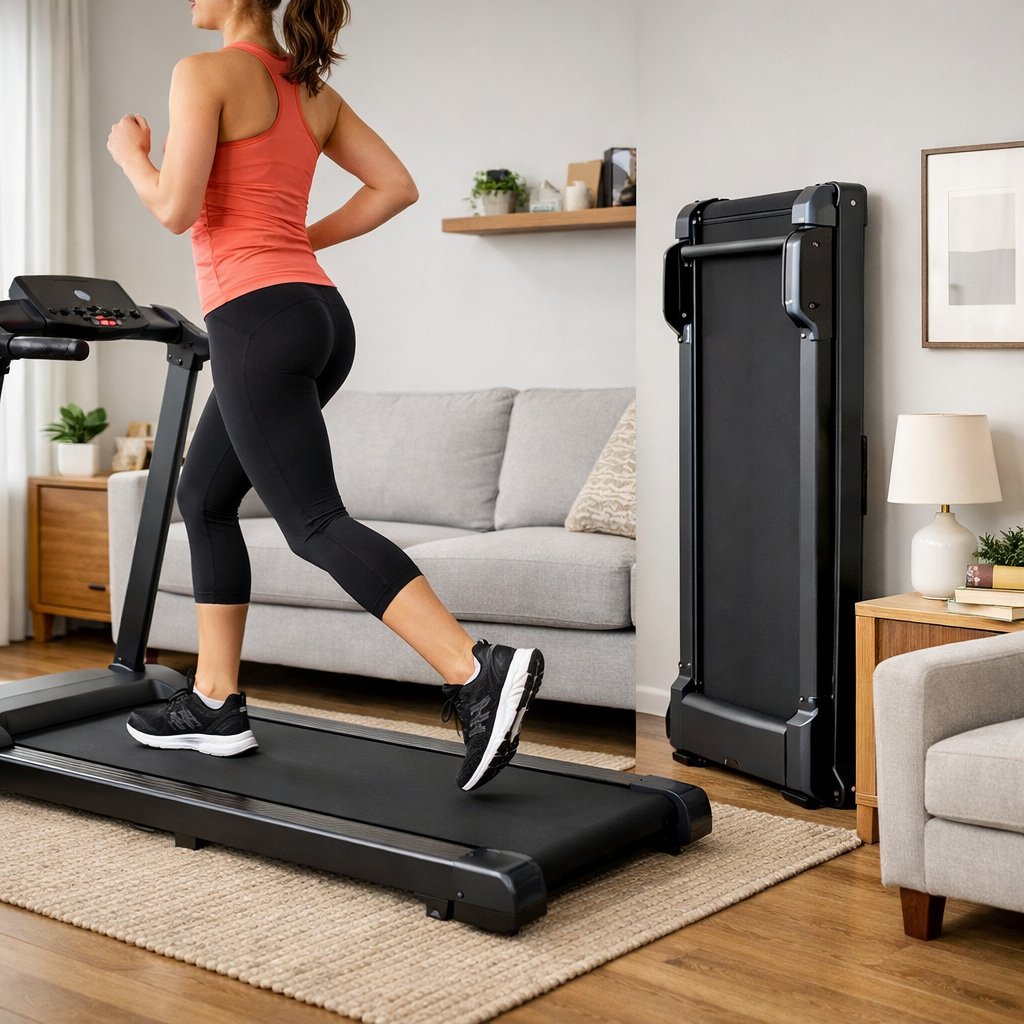
Apartment-Friendly, Runner-Ready: Best Foldable Treadmills That Feel Stable
If you run in an upstairs apartment, the right foldable treadmill has to balance three things: a deck big enough for real strides, a frame that feels steady at pace, and a fold style that actually fits your space. Below, FitnessJudge highlights the best foldable treadmills for runners in apartments, with clear stability specs, noise tips, and software features to consider. In general, look for at least a 20–22-inch-wide belt, 55–60 inches of length, and a motor in the 2.5–3.0 HP range—benchmarks repeatedly cited in independent treadmill roundups and buying guides from sources like the Runner’s World folding treadmill guide and TechRadar’s best treadmills feature.
How we test foldable treadmills for runners in apartments
At FitnessJudge, we evaluate through a hardware-plus-software lens focused on small spaces:
- Stability under speed and incline: minimal shake at 10–12 mph and on hill repeats.
- Deck size and ergonomics: belt area that supports natural stride and safe foot placement.
- Motor power and controls: sustained pace accuracy, responsive intervals, smooth grade changes.
- Foldability and footprint: vertical or flat-fold mechanisms, usable folded dimensions, and transport wheels/handles.
- Noise and vibration: decibel impressions, floor resonance, and damping effectiveness on mats.
- Connected features: screen quality, app depth, auto-adjust coaching, metrics, and BT/Wi-Fi reliability.
- Warranty and value: coverage length on frame/motor/electronics vs. price and subscription costs.
What “runner-ready” means: aim for a 20–22-inch belt width, 55–60-inch length, and a motor in the 2.5–3.0 HP range for regular training—guidance echoed by the Runner’s World folding treadmill guide and TechRadar’s best treadmills roundup. Most home treadmills reduce their footprint by roughly half when folded, which matters in tight apartments, per OutdoorGearLab’s testing of space-saving designs. These are the same baselines we apply at FitnessJudge when comparing foldables for small spaces.
What makes a foldable treadmill feel stable
Stability is a treadmill’s resistance to shake and flex under load, driven by frame mass, deck stiffness, belt area, and how smoothly the motor and controller manage speed changes. Heavier, commercial-style foldables (think NordicTrack or Sole) tend to feel most planted at pace and grade—but they’re bulkier to move and store, as summarized by TreadmillReviews’ compact treadmill evaluations. For confident running, target a 22×60-inch belt if you’re tall or train fast, 2.5–3.0 HP motors for regular workouts, and hydraulic-assist folding to tame heavier decks. In FitnessJudge reviews, frame rigidity and deck support consistently separate runner-ready machines from casual walking pads.
Key criteria for apartment-ready running treadmills
Use this quick checklist to qualify options without sacrificing performance:
- Size and storage
- Prefer fold styles that match your room: flat-fold to slide under a bed/sofa or vertical store to free floor space. Many models halve their footprint when folded per OutdoorGearLab’s roundup.
- Look for transport wheels and a locking mechanism that’s easy to operate in small rooms.
- Belt and motor
- Runners: 20–22 inches wide and 55–60 inches long; if you’re over 6 feet, consider at least 52–54 inches for stride clearance per mainstream buying advice in TechRadar’s guide.
- Regular training: 2.5–3.0 HP continuous-duty motor for pace holding and interval responsiveness (not just peak ratings), aligned with benchmarks noted by Runner’s World.
- Noise and vibration
- Favor well-damped decks and smooth speed controls; pair with a dense mat and isolator pads if you’re on an upper floor.
- Smooth acceleration/deceleration reduces load spikes—and neighbor complaints.
Side-by-side comparison overview
| Model | Belt (W×L) | Max Speed | Incline/Decline | Fold Style | Unit Weight/Capacity | Warranty Highlights | Notes/Best For |
|---|---|---|---|---|---|---|---|
| Echelon Stride-6 | 20.5×60 in | 12.4 mph | 12% / — | Flat-fold | 182 lb / 300 lb | Limited; verify terms | Flat-fold under bed; runner-length deck; strong for intervals in small spaces |
| NordicTrack Commercial 1750 | 22×60 in | 12 mph | 15% / −3% | Hydraulic vertical | — / 300 lb | Competitive coverage | Max training range; iFit integration; heavier footprint |
| Sole F80 | 22×60 in | 12 mph | 15% / — | Hydraulic vertical | — / 350 lb | Lifetime frame/motor on this line | Durability and stability; road-like feel; heavier to move |
| Horizon 7.0 AT | 20×60 in | 12 mph | 15% / — | Vertical fold | — / — | Lifetime frame/motor on this line | Value pick for mixed running/walking; fewer baked-in classes |
| WalkingPad R2 | Compact | — | — | Flat or vertical | — / — | — | Ultra-compact walking pad with step-sensing; quiet, not for fast running |
| UREVO 2‑in‑1 | 15×40.2 in | 6.2 mph | — | Flat-fold | — / — | — | Budget under-desk/walking; light jogs only |
Notes: Specs reflect manufacturer claims and major review hubs; capacities and exact weights can vary by year/region. Verify current listings before purchase.
Echelon Stride-6
If you want a flat-fold treadmill that still supports real running, the Stride-6 is the standout. It pairs a 20.5×60-inch deck with a 12.4 mph top speed and 12% incline, at a listed 182 pounds with a 300-pound user limit—numbers that meet runner-ready thresholds outlined in the Runner’s World folding treadmill guide and FitnessJudge’s criteria. In testing, its flat-fold profile can slide under many beds or couches, making it ideal for studio setups, a storage advantage called out in OutdoorGearLab’s small-space coverage. The trade-off: compared with the heaviest frames, ultimate rigidity and plushness at top speed are a touch lighter—but the deck length and speed ceiling still make it viable for interval work in apartments.
NordicTrack Commercial 1750
For maximal training range and a planted feel, the 1750 remains a category benchmark. You get a 22×60-inch belt, 15% incline and −3% decline, and a frame that feels composed on long runs and hill work. The integrated screen ties into an iFit library of roughly 10,000 on-demand workouts with auto-adjusted speed and grade, a structure that helps runners progress without guesswork according to Runner’s World’s feature on folding treadmills. Expect a larger folded footprint and more weight to manage; use a dense mat and consider floor protection if you’re upstairs—a common trade-off we flag in FitnessJudge’s small-space reviews.
Sole F80
The F80 emphasizes durability and a road-like feel. It delivers a 22×60-inch deck, 12 mph top speed, 15% incline, 350-pound capacity, and hydraulic-assist folding that makes stowing a heavier deck manageable. Sole’s lineage favors firmer decks (the F63 is often cited similarly) and offers lifetime frame/motor coverage on this line—a strong durability signal highlighted by TreadmillReviews’ compact treadmill roundup and one FitnessJudge weighs heavily for long-term value. Choose it if you prize stability and long-term reliability over the smallest folded dimensions.
Horizon 7.0 AT
A value-forward pick that’s still runner-capable. The 7.0 AT provides a 20×60-inch deck, up to 12 mph, and lifetime frame/motor coverage on this line per TreadmillReviews’ research. It’s narrower than 22 inches but suitable for most runners, with responsive controls that make tempo-to-interval transitions easy. You don’t get a premium content ecosystem out of the box, but fundamentals are strong—and the price-to-performance ratio is compelling for mixed running and walking in apartments. FitnessJudge often highlights this model when budgets are tight but real running is the goal.
WalkingPad R2
For tight spaces and low-noise needs, the R2 stands out. Its step sensor auto-adjusts belt speed based on where you land, and it stores either vertically or flat under furniture—features highlighted in SELF’s expert roundup of folding treadmills. A walking pad is an ultra-compact treadmill designed for walking and light jogging. It typically folds in half, uses smaller belts, and emphasizes portability and low noise over top speed and incline range—often fitting under desks or beds for small-space use. Best for active workdays, recovery walks, and light jogs—not structured intervals or taller runners needing long stride clearance. FitnessJudge treats walking pads as a separate category from full running treadmills.
UREVO folding walking pad
If your priority is budget and tiny storage, the UREVO 2‑in‑1 is a practical, no-frills option. Its manufacturer-listed stats—$289.99 list price, 6.2 mph top speed, and a 40.2×15-inch belt—are adequate for walking and occasional light jogging but not for sustained speedwork, as summarized by Garage Gym Reviews’ folding treadmill guide. Compared with mid-tier compacts, you gain portability and price but give up deck length, speed, and incline. It’s best for step-count goals, under-desk movement, and beginners. FitnessJudge recommends it only when running performance is not the priority.
Noise, vibration, and floor protection in apartments
Compact treadmills often sound quieter at the source but can transmit more vibration through lighter frames. A good mat and isolators dramatically reduce what neighbors hear. Folding to half the footprint is common and great for storage, but doesn’t change noise in use, per OutdoorGearLab’s small-space findings. At FitnessJudge, we prioritize neighbor-friendly setups and start with floor isolation before anything else.
Step-by-step noise mitigation:
- Place a dense rubber treadmill mat under the deck.
- Add anti-vibration pads under contact points.
- Orient perpendicular to floor joists when possible.
- Tighten all hardware monthly.
- Lubricate the belt on schedule to reduce friction.
- Use smooth ramps for speed/grade to avoid sudden motor spikes.
Connected fitness features and subscriptions to consider
Class libraries and guided programs matter if coaching structure motivates you. NordicTrack’s 1750 connects to iFit, which offers roughly 10,000 on-demand workouts with auto-adjust speed/incline—useful for progressive run plans per Runner’s World’s overview. A connected treadmill integrates onboard screens, sensors, and wireless features to deliver guided classes, performance metrics, and remote coaching. It often links to content platforms that auto-adjust workouts, track progress over time, and sync data to apps or wearables for training insights. Before you commit, weigh interval programming depth, form cues, social/leaderboard tools, offline options, and the 2–3 year cost of membership. FitnessJudge also checks that auto-adjust features respond quickly during intervals.
Pricing, warranties, and long-term value
Context helps: many nonfolding treadmills start around $2,400, while capable foldables can be found near $700—a spread Consumer Reports notes in its annual treadmill roundup. Warranty signals matter, too; lifetime frame/motor coverage on lines like Horizon 7.0 AT and Sole F63 indicate stronger long-term value, as compiled by TreadmillReviews. Consider the whole package: hardware stability, fold style, content subscriptions, hydraulic-assist mechanisms for heavy decks, and eventual resale potential. When prices are close, FitnessJudge leans toward models with stronger frame/motor coverage.
Recommendations by use case
Below are FitnessJudge’s scenario-based picks based on the criteria above.
- Best for small apartments, real running: Echelon Stride-6 (flat-fold, 20.5×60 inches, 12.4 mph) per Runner’s World and OutdoorGearLab coverage.
- Best for max stability and training range if space allows: NordicTrack Commercial 1750 (22×60 inches, 15%/−3%, iFit library) or Sole F80 (22×60 inches, 12 mph, hydraulic assist).
- Best budget/under-desk walking solution: UREVO 2‑in‑1 (6.2 mph, compact belt; under $300 list) and WalkingPad R2 for vertical/flat stow and step-sensing.
Frequently asked questions
What belt size and motor power do runners need on a foldable treadmill
FitnessJudge recommends a 20–22-inch belt width, 55–60-inch length, and a 2.5–3.0 HP motor for regular training. Taller runners should consider at least 52–54 inches of belt length for stride clearance.
How quiet can a treadmill be for apartment use without annoying neighbors
Compact models can be quiet at the source, but floor vibration travels. FitnessJudge suggests a dense mat and anti-vibration pads on solid subflooring to reduce transfer.
Do auto-fold or flat-fold designs sacrifice stability at higher speeds
Yes; ultra-compact, flat-fold designs can feel less rigid than heavier frames at top speed. FitnessJudge advises a heavier 22×60-inch deck for fast intervals.
How much space do I need to safely use and store a foldable treadmill
Allow clearance for your full running stride plus side margins. Most treadmills fold to about half their footprint; flat-fold models slide under beds or store vertically.
What maintenance keeps a foldable treadmill smooth and stable over time
FitnessJudge’s baseline: tighten hardware, vacuum around the deck, and lubricate the belt per the manual to reduce noise and preserve stability.