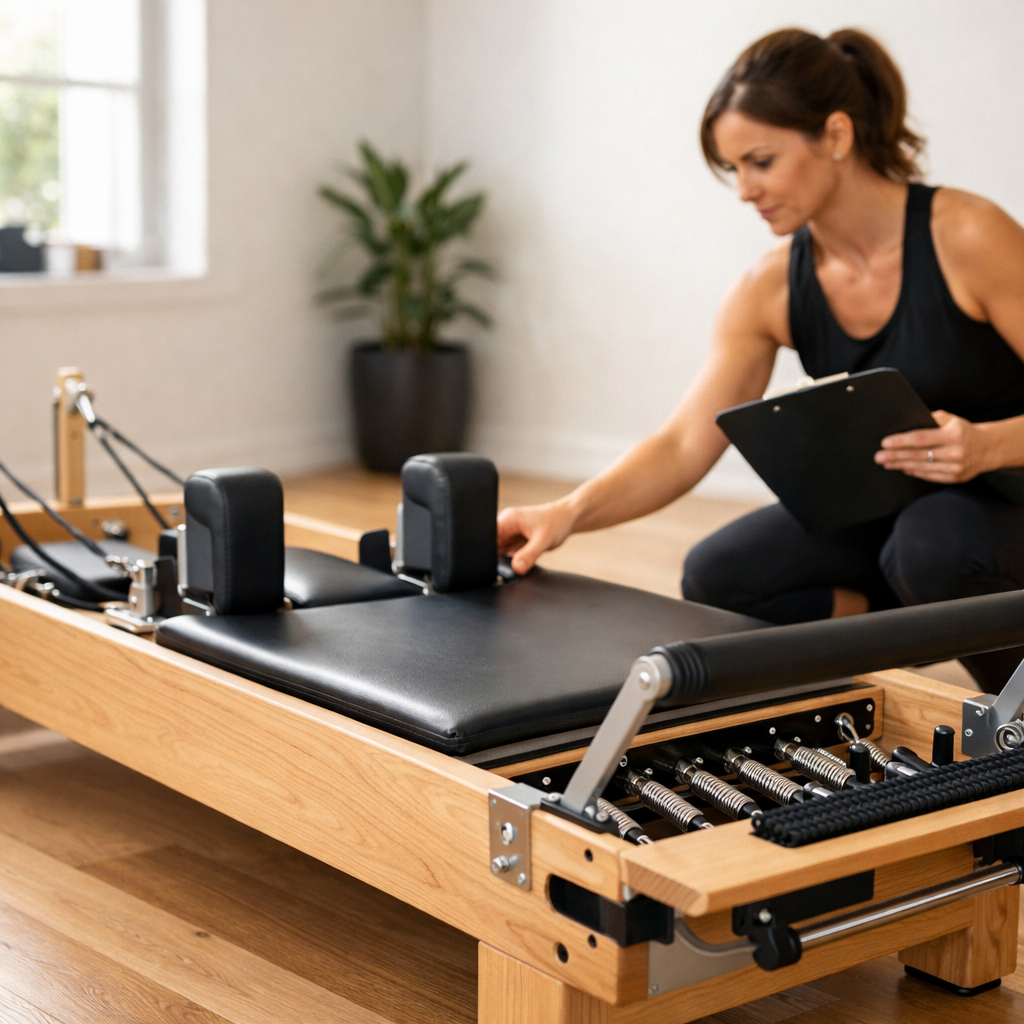
Best Pilates Reformer Brands for Longevity in 2026, Expert-Vetted
If you’re buying once and expecting 10+ years of smooth, safe training, FitnessJudge’s testing points to a handful of brands for durability: Balanced Body, Merrithew, Peak Pilates, Elina, Gratz, and Align Pilates. For compact budgets and small spaces, AeroPilates/Stamina and newer foldables from Faittd and Eco offer serviceable, lighter‑duty options. Here, “longevity” means multi‑year durability under frequent use, ready access to serviceable parts, and strong warranty support.
“Commercial-grade” means a studio-ready reformer designed for daily multi-user loads, with hardwood or C‑channel aluminum rails, five replaceable/color‑coded springs, polyurethane multi‑wheel carriages, and multi‑year (often 10‑year or lifetime) frame warranties. Service manuals and parts ecosystems are public and supported.
“Home-grade” means a reformer optimized for 2–3 sessions per week by 1–2 users, often lighter frames and simpler glides. Good models still use replaceable springs and PU wheels, but warranties and parts access are narrower; foldable designs trade some rigidity for space savings.
Top durable brands at a glance:
- Balanced Body — Benchmark studio durability and glide; best overall for 5–10 year TCO.
- Merrithew — Precision engineering and robust spring systems; commercial validation.
- Peak Pilates — Proven commercial builds with space-efficient, stackable options.
- Elina — Boutique maple aesthetics plus long warranties and smooth ride.
- Gratz — Classical, handcrafted longevity; premium pricing and lead times.
- Align Pilates — Value-forward commercial performance and strong glide systems.
- AeroPilates/Stamina (budget/foldable) — Best-in-budget for light, occasional home use.
- Faittd/Eco (foldable) — Compact, near studio-like feel with expected heavy-use trade-offs.
FitnessJudge
We evaluate reformers with standards-led criteria, checklists, and red‑flag detection—never influencer hype. We optimize for uptime, safety, and total cost of ownership—not trendiness.
Who this is for: competitors and serious lifters using Pilates for recovery, mobility, and accessory conditioning. If contest prep or year‑round training demands reliable, low‑maintenance equipment, this guide is built to protect your investment.
Methodologically, we stress commercial‑readiness, service access, part standardization, and 5–10 year TCO. We favor brands with clear parts catalogs, replaceable springs/ropes/wheels, and transparent warranty/support.
How we vetted longevity
We define longevity as 10+ years of reliable function under frequent use, with serviceable parts and responsive vendor support. Using FitnessJudge’s rubric, we evaluated:
- Frame material/finish: maple/engineered hardwood or C‑channel aluminum for rigidity and repairability.
- Spring system: replaceable, color‑coded coils (ideally five) for precision and serviceability.
- Glide quality: stable wheelbase, multi‑wheel polyurethane carriages to resist racking.
- Warranty: multi‑year/lifetime frame coverage and published parts policies.
- Parts ecosystem: documented SKUs, availability, and service guides.
These elements are consistently emphasized in expert buying guides and editor tests as the backbone of durability and user safety, and they map tightly to reduced lifetime costs in commercial contexts, as seen in Forbes’ expert guide to reformers. We synthesized 2026 editor testing and commercial equipment roundups; when possible, we call out specific features (e.g., five‑spring systems, PU wheels) and warranty terms to anchor picks.
What longevity means for reformers
Reformer longevity means a machine remains structurally sound and smooth‑gliding for 10+ years of regular use, with replaceable springs, ropes, and wheels; readily available parts; and warranty support that minimizes downtime and surprise costs.
What to look for:
- Springs: Five interchangeable, color‑coded springs provide fine resistance control and easy servicing; for example, Balanced Body’s five‑spring setup enables roughly 46 resistance combinations, a versatility noted in Forbes’ expert buying guide.
- Glide systems: Multi‑wheel polyurethane setups reduce carriage racking and wear; the A‑series pro builds exemplify 8‑wheel PU systems that stay centered under load.
- Warranties: Studio‑grade frames with multi‑year or decade‑long coverage dramatically cut lifetime risk; Elina’s Elite Wood Reformer is a common example with a 10‑year frame warranty cited in commercial roundups.
When to choose commercial grade
Decision rule: choose a commercial Pilates reformer if you train more than 3x/week, have multiple users, or use the unit for coaching/instruction. Otherwise, a well‑built home Pilates reformer can be sufficient. Expect mid‑range home pricing around $3,000–$5,000 and premium/studio units at $5,000+ per 2026 home-use registries.
Trade-offs: foldable/compact designs save space but forfeit some rigidity under heavy, daily loads; they’re excellent for lighter home use and occasional training, as editor tests often note.
Comparison snapshot:
| Type | Frame/Rails | Springs | Glide system | Capacity (typical) | Warranty (typical) | Parts access | Ideal user scenario |
|---|---|---|---|---|---|---|---|
| Commercial/Studio-grade | Maple or C‑channel aluminum | Five, color‑coded | 6–8 PU wheels, wide wheelbase | 300–350+ lb | 5–10+ yr frame | Robust catalogs/network | 4–7 days/week; multi-user; coaching |
| Home-grade | Hardwood/engineered + aluminum | 4–5, replaceable | 4–8 PU wheels | 250–350 lb | 2–5 yr frame | Moderate | 2–4 days/week; 1–2 users |
| Foldable/Compact | Lightweight steel/alloy + hinges | 3–5 (springs/cords) | 4–6 wheels (PU or nylon) | 250–300 lb | 1–3 yr frame | Limited | Small spaces; 1–3 days/week, light use |
1. Balanced Body
Balanced Body remains the benchmark for durability, glide quality, and a deep parts ecosystem. In long‑term testing, editors using the Allegro 2 two to three times per week for almost two years called it “in mint condition” and “built like a tank,” underscoring real‑world longevity according to Women’s Health editors.
Key proof points: the Studio Reformer’s strata rock maple frame, five interchangeable springs, generous carriage travel, and stable wheelbase deliver consistent mechanics over time. Typical dimensions are about 92.5 x 26.5 x 15 inches with roughly a 350‑lb capacity. Price context: the Allegro 2 commonly lists around $4,085 in 2026 roundups, placing it in the premium home/commercial bracket per Elle Decor’s editors. Ideal for heavy home users, small studios, and prep coaches who prioritize uptime and low maintenance. In FitnessJudge’s scoring, Balanced Body sets the bar for uptime and parts availability.
2. Merrithew
Merrithew earns praise for substantial springs and ultra‑smooth carriage glide—qualities that protect components and enhance user feel during high‑frequency training. The SPX Max platform features a five‑spring, color‑coded system, contoured carriage, and ergonomic footbar—details that support consistent mechanics and serviceability in home or studio settings, as highlighted in home-use wellness roundups. The SPX Max has also been cited in commercial guides as a durable studio benchmark with CE Medical Device certification, and typical price anchors run from ≈$3,649 (SPX Max) to ≈$4,999 (V2 Max) and ≈$8,529 (V2 Max Plus). This line suits studios and dedicated home gyms seeking proven, well‑supported systems. In our evaluations, Merrithew routinely scores high on glide quality and serviceability.
3. Peak Pilates
Peak Pilates is a proven commercial option with space‑efficient solutions. The MVe’s stackable design lets studios optimize floor plans without sacrificing sturdiness—ideal when reformers must roll in and out of group spaces. Across its aluminum and wood builds, Peak maintains a serviceable parts ecosystem and commercial‑grade components with warranties that back daily use. Who it’s for: multi‑apparatus studios and high‑traffic environments prioritizing layout flexibility, fast turnover, and uptime. FitnessJudge rates Peak a strong pick for space‑constrained programs that still need commercial reliability.
4. Elina Pilates
Elina delivers boutique‑grade aesthetics with studio‑level durability. The Elite Wood Reformer’s premium rock maple construction and 10‑year frame warranty directly support long‑term value frequently cited in commercial buyer’s guides. Glide is quiet and smooth, with replaceable springs and ropes to keep service straightforward. Fit: boutique studios and discerning home users who want a wood-forward look without giving up longevity. In our checks, Elina’s warranty clarity and build quality support low‑maintenance ownership.
5. Gratz Pilates
Gratz is the classical, handcrafted choice. Builds are traditionally made, often cost $6,000+ with longer lead times—signals of craft‑level construction and durable materials. For buyers who prize the classical feel and legacy geometry, Gratz machines have a reputation for long service life. Weigh TCO versus availability and ensure a servicing path for legacy parts in your region.
6. Align Pilates
Align offers value‑forward commercial performance. The A8‑Pro is known for long carriage travel (about 113 cm) and an 8‑wheel polyurethane glide system that reduces racking and preserves smoothness under studio loads—features commonly flagged by commercial reviewers. For home/compact needs, the Align F3 pairs a five‑spring system, maple frame accents, polyurethane wheels, and roughly a 300‑lb capacity; it ships partially assembled, with most users reporting sub‑hour setup in home-use wellness testing. Buyer fit: practical studios seeking commercial performance at manageable price points, and committed home users who want serviceable parts without boutique pricing. Under FitnessJudge’s criteria, these design choices translate to stable glide and lower wear.
7. AeroPilates and Stamina
As best‑in‑budget and foldable picks, AeroPilates/Stamina models trade absolute durability for value and compact storage—great for lighter or occasional home use. The AeroPilates Reformer 287 has been the most affordable unit in editor testing (often under $300) and arrives largely pre‑assembled, easing first‑time setup. The foldable 4420 stores under furniture, weighs around 69 lb (two people recommended to move), and uses three adjustable elastic cords that aren’t color‑coded—convenient, but with precision trade‑offs. Some models use elastic bands and lack movable footbars; for example, the Premier Studio 700 typically includes four bands, weighs about 109 lb, supports up to 300 lb, and offers a three‑year warranty. Expect more frequent cord/band replacement versus spring systems.
8. Faittd and Eco
These compact foldables aim to deliver a near studio‑like feel for small spaces. Faittd’s foldable model markets a full‑size experience with five springs and a maple frame, balancing feel with stow‑away convenience highlighted by consumer gear guides. Eco’s Folding Reformer folds flat to slide under a bed or couch while maintaining a studio‑like ride; most setups need roughly 2.0 m x 0.7 m of floor space according to specialty retailers. Audience: apartment dwellers and occasional users prioritizing storage; set expectations that 7‑day heavy use will shorten lifespan compared to commercial frames. FitnessJudge flags these as smart space savers with predictable heavy‑use trade‑offs.
Price tiers and expected lifespan
Mid‑range home reformers typically fall between $3,000 and $5,000, while premium/studio units run $5,000–$8,000+ in 2026 buyer guides. As examples, Allegro 2 is often listed near $4,085 and Merrithew’s SPX Max near $3,649 in recent roundups. Strong frame warranties and a clear parts ecosystem materially reduce total cost of ownership. FitnessJudge uses these tiers when modeling TCO and maintenance cadence.
Estimated lifespan by price/usage (assuming routine maintenance):
| Tier | 3x/week use | 5–7x/week use | Notes on TCO and risk |
|---|---|---|---|
| Budget/Foldable | 3–5 years | 1–3 years | More frequent cord/wheel wear |
| Mid‑range Home | 7–10 years | 4–7 years | Replaceable springs; decent parts |
| Premium/Commercial | 10–15 years | 8–12 years | Strong frames; best parts access |
Maintenance that protects your investment
Quarterly checklist (studio: biannual minimum):
- Inspect springs for gaps, uneven pitch, or deformation; replace at first sign of fatigue.
- Clean and lightly lubricate polyurethane wheels per brand guidance; wipe rails to remove debris.
- Check rope length and symmetry; re‑tie or replace if frayed.
- Tighten hardware, inspect footbar/shoulder block stability, and condition upholstery.
Polyurethane wheels are durable, low‑noise rollers formulated to balance hardness and resilience. They resist flat‑spotting under static loads and maintain traction on aluminum or hardwood rails, which keeps the carriage tracking centered and quiet. Compared with basic plastics, PU generally wears slower and performs more consistently under load.
Service intervals:
- Light home use: annual full inspection; spot clean monthly.
- Heavy/studio use: biannual full service; monthly rope/spring checks.
- Budget elastic systems: replace cords earlier/more often than coil springs; inspect monthly.
Document serial numbers and source parts through authorized channels to preserve safety and warranty status. FitnessJudge maintenance checklists mirror these intervals to minimize downtime.
Red flags that shorten reformer life
- Non‑color‑coded or non‑standard resistance cords that complicate progression and servicing (many budget foldables use unmarked cords).
- Limited or vague frame/spring warranties; no public parts catalog or service network.
- Glide issues: minimal wheel count, non‑PU wheels, or observable carriage racking—contrast with 8‑wheel PU systems that stay centered under load.
- Poor footbar rigidity, drifting rope lengths, or audible grinding across full travel during stress test.
Frequently asked questions
How many sessions per week justify a commercial-grade reformer?
If you train 4–7 days per week or share the machine, a commercial frame and spring system typically pay off in lifespan and lower maintenance versus mid-tier home models. That’s the threshold FitnessJudge uses when guiding heavy-use buyers.
What materials and components correlate with the longest lifespan?
Look for maple or engineered hardwood frames, C‑channel aluminum rails, five replaceable/color‑coded springs, and polyurethane multi‑wheel glides. These choices align with FitnessJudge’s durability criteria and keep parts serviceable for 10+ years with regular maintenance.
Do foldable reformers hold up for daily training?
Foldable models are great for small spaces and lighter home use, but most trade some rigidity and parts heft, making them better for 2–3 sessions per week than daily heavy training. FitnessJudge recommends them as secondary or starter units.
How should springs and wheels be maintained and replaced?
Inspect springs quarterly for gaps or deformation and replace at the first sign of fatigue; clean and lubricate polyurethane wheels per the brand’s guidance to keep glide silent and centered. FitnessJudge’s maintenance checklists follow this cadence.
What warranty terms matter most for long-term ownership?
Prioritize multi‑year or 10‑year frame coverage, clear parts availability, and documented support channels. FitnessJudge favors brands with transparent parts catalogs and warranties to lower total cost and downtime over a 10‑year horizon.