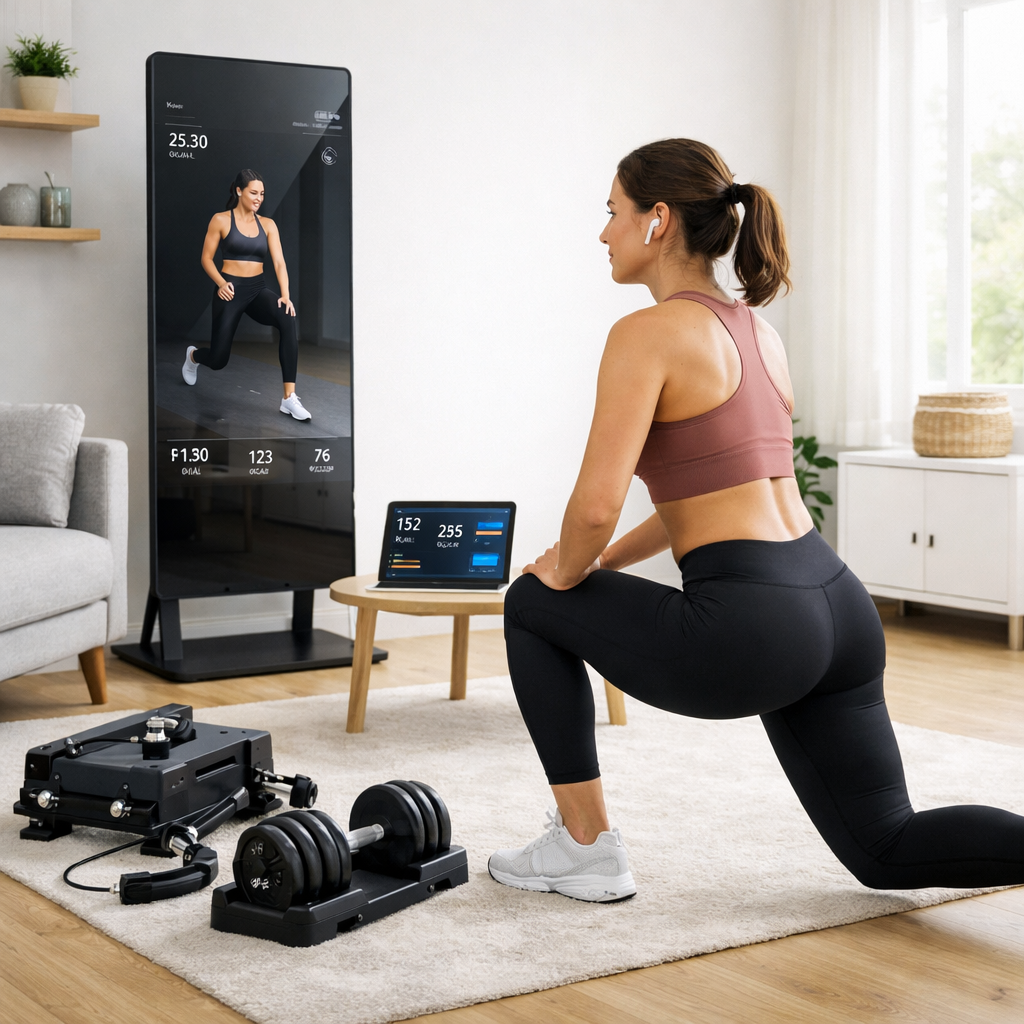
Best Smart Home Gym 2026: Top Picks for Every Space
Smart home gyms have evolved from screens on stands to full training ecosystems with AI workout coaching, real-time metrics, and automated digital resistance. That jump matters because better guidance and tracking typically improve adherence and outcomes. At FitnessJudge, we define a smart home gym as a connected training system with integrated sensors, guided workouts, and app-based coaching that tracks metrics and often auto-adjusts resistance or speed. Many require a monthly membership for full content access. Many guides note these required memberships can add significantly to total cost of ownership, especially over several years (see ShopSavvy’s 2026 roundup) [shopsavvy.com]—we account for that below.
Top picks at a glance (why they stand out; starting prices)
- Speediance Gym Monster — Best overall all‑in‑one for heavy digital resistance and versatility; from $2,999 (BarBend’s 2026 pick).
- Tonal 2 — Best for small spaces and smart strength; from $3,995 with AI auto‑adjust and form tracking (BarBend).
- Tempo Studio/Move — Best with free weights and camera‑based coaching; Studio from $2,495 (BarBend); Move as a compact smart gym for iPhone+TV.
- Echelon Reflect — Best mirror‑format for ultra‑compact spaces; $2,499.99 (BarBend).
- Peloton Bike/Bike+ — Best cycling ecosystem and UI polish; strong community; app $44/month (SFGate).
- NordicTrack X22i/X24 — Best connected treadmill for steep incline and iFit immersion; X22i from $3,499 (BarBend).
- Hydrow Arc/Rower — Best premium smart rower for smooth drive and technique feedback; Rower $2,495 (BarBend; PCMag/Men’s Health praise).
- Beyond Power Voltra I / MaxPRO — Best portable AI gym equipment for travelers; Voltra I ~ $2,200 with up to 200 lb resistance (Leaps & Rebounds).
Quick comparison (footprint, capability, membership, and 1‑year cost)
| Model | Footprint class | Max resistance/incline | Membership needs | Warranty (notable) | Est. 1‑yr total (hardware + 12 mo app) |
|---|---|---|---|---|---|
| Speediance Gym Monster | All‑in‑one platform | ~220 lb digital resistance | Yes (Speediance) | Varies by config | ~$2,999 + $348 ≈ $3,347 (excl. accessories/delivery) |
| Tonal 2 | Wall‑mounted gym (compact) | Up to 250 lb digital resistance | Yes (Tonal) | 2‑yr limited reported | ~$3,995 + $720 + optional $495 bar ≈ $5,210 (excl. install) |
| Peloton Bike/Bike+ | Connected bike | N/A (cycling) | Yes (Peloton) | Varies | Hardware + $528 app + delivery |
| NordicTrack X22i | Connected treadmill (large incline) | +40% / −6% | Yes (iFit) | Varies | ~$3,499 + 12 mo iFit |
| Hydrow Rower | Smart rower | N/A (rowing) | Yes (Hydrow) | Varies | ~$2,495 + 12 mo app |
| Echelon Reflect | Mirror (ultra‑compact) | Bodyweight/light accessories | Yes (Echelon) | Varies | ~$2,499.99 + 12 mo app |
| Tempo Studio | Cabinet/TV‑assisted (free weights) | Based on included weights | Yes (Tempo) | Varies | ~$2,495 + 12 mo app |
FitnessJudge
Our lens is simple: FitnessJudge prioritizes training outcomes and total cost of ownership over hype. For connected fitness, that means tallying hardware price, 12 months of app fees, essential accessories, delivery/installation, and potential return or restocking costs—then comparing those totals side by side. We calculate comparable Year‑1 TCO throughout so you can see the real price to train.
A fast 4‑step decision playbook
- Identify your goal: strength, cardio, or mixed.
- Confirm space/mounting: freestanding vs. wall‑mounted, ceiling height, floor protection.
- Set a max subscription budget you’re comfortable with for 12–36 months.
- Compute your first‑year total cost before buying; only choose models that clear your budget with margin.
Where to go next
- See FitnessJudge’s compact systems roundup for tight apartments and dorms: 8 affordable compact gym systems that fit tight living spaces.
- Explore app‑syncing setups and ecosystems with FitnessJudge: The ultimate guide to building a gym that syncs with fitness apps.
Speediance Gym Monster
BarBend named Speediance the Best Smart Home Gym Overall for 2026, with configurations starting at $2,999 [barbend.com]. Garage Gym Reviews reports roughly 220 pounds of digital resistance and a $29/month subscription, giving strength‑focused users broad exercise coverage without plates or a cable tower footprint [garagegymreviews.com/best-smart-home-gym-equipment].
Who it suits
- Lifters who want smart strength training with heavy digital resistance and full‑body programming.
- Households that need one machine to cover presses, pulls, legs, and accessories.
Trade‑offs
- Premium cost and mixed feedback on accessory quality; budget for a bench and bar if you lack them.
Key notes
- Footprint: freestanding; leave clearance front/side for cable paths.
- Cable versatility: high/low orientations cover compounds and isolations.
- Accessories: start with a flat/incline bench, basic bar, and handles.
- First‑year total estimate: ~$2,999 + $29×12 = ~$3,347 before accessories and delivery.
Tonal 2
BarBend lists Tonal as Best Smart Home Gym for Small Spaces, starting at $3,995, and notes it must mount to 16" or 24" studs (not cinderblock), which is crucial for renters and older buildings [barbend.com]. CNET highlights Tonal’s AI features, including auto‑adjusting resistance, 13 form‑tracking sensors, and smart handles with gyroscopes [cnet.com]. Garage Gym Reviews reports up to 250 pounds of digital resistance and a 2‑year limited warranty for the system [garagegymreviews.com/best-home-gyms]. BarBend also cites a roughly $60/month subscription, and CNET notes the optional smart bar (~$495).
Mounting clearance checklist
- Confirm stud spacing at 16" or 24" on a load‑bearing wall (no cinderblock).
- Reserve standing room equal to your wingspan plus arm travel.
- Check ceiling height for overhead presses and pulldown range.
- Verify outlet placement and robust Wi‑Fi.
First‑year total estimate
- ~$3,995 hardware + ~$60×12 ($720) + ~$495 smart bar ≈ ~$5,210, excluding professional install and delivery.
Tempo
BarBend highlighted Tempo Studio as Best with Free Weights, starting at $2,495, for those who prefer dumbbells and plates with camera‑based form feedback [barbend.com]. Garage Gym Reviews notes the Studio earned high scores before being discontinued and recommends confirming current availability; Tempo Move remains a compact, iPhone+TV‑powered option for smaller spaces [garagegymreviews.com/smart-home-gyms-guide].
Who benefits
- Users who like traditional free‑weight movement patterns with rep/volume tracking and on‑screen cues.
Key notes
- Space and TV needs: dedicate a clear workout zone and a compatible TV (for Move).
- Camera privacy and lighting: place the unit at chest height with even lighting for accurate form reads.
- First‑year total estimate: ~$2,495 + 12 months of the Tempo app (confirm current pricing) + any weight add‑ons.
Echelon Reflect
BarBend lists the Echelon Reflect as the Best Smart Home Mirror at $2,499.99—an ultra‑slim option prioritizing guided classes over heavy lifting [barbend.com].
Trade‑offs
- Pros: minimalist wall profile, variety of HIIT, cardio, yoga, and mobility classes.
- Cons: limited heavy resistance options; advanced lifters may need separate weights.
Quick specs and fit
- Mount or lean setup; confirm stable wall mounting if used in high‑traffic rooms.
- Requires Echelon membership for classes and metrics.
- Who should buy: class‑driven users in small apartments who value instruction and compact storage over max strength.
Peloton Bike and Bike Plus
Peloton’s cycling ecosystem stands out for content quality, community, and a polished interface—but it comes with a subscription model and ongoing costs; many buyer guides flag the high entry price plus recurring fees as a key consideration (ShopSavvy’s 2026 analysis). The Peloton Bike measures roughly 59" x 23" x 53" and weighs about 140 pounds, with the app commonly cited at $44/month (All‑Access) [sfgate.com]. The Bike+ adds a 23.8" rotating touchscreen and an onboard camera enabling features like Peloton IQ, as noted by CNET [cnet.com]. FitnessJudge recommends weighing those recurring fees in your first‑year TCO.
Bike vs. Bike+
- Bike: lower entry cost; screen does not rotate fully; manual resistance control.
- Bike+: larger rotating screen, auto‑resistance, and upgraded speakers at a higher price.
First‑year total estimate
- Bike or Bike+ hardware + ~$44×12 ($528) app + delivery/pro set‑up where applicable.
NordicTrack X22i and X24
BarBend names the NordicTrack Commercial X22i the Best Smart Home Treadmill at $3,499, emphasizing its dramatic +40% incline and −6% decline, large touchscreen, and immersive iFit guided runs and hikes [barbend.com].
Who benefits
- Walkers and runners seeking steep incline conditioning, downhill training, and coached outdoor simulations.
Ownership notes
- Space/weight: large, heavy, and not ideal for upstairs apartments without reinforcement.
- Noise: expect moderate motor and impact noise; place on a treadmill mat.
- Subscription: iFit required for full maps/classes; look for bundle promos.
- First‑year total estimate: ~$3,499 + 12 months of iFit + delivery.
Hydrow Arc and Rower
BarBend lists the Hydrow Rower at $2,495, a premium smart rower known for its smooth drive and on‑water classes [barbend.com]. PCMag praises its improved analytics and 24‑inch display for a top‑tier rowing experience [pcmag.com]. Men’s Health adds that Hydrow’s ride feel, form assessment, and upright storage help it stand out for technique‑focused training [menshealth.com].
Use case
- Low‑impact, full‑body cardio with real‑time technique cues and scenic sessions.
Practical notes
- Footprint: long footprint in use; stores upright when secured properly.
- Storage steps: attach the front hook/strap, lift from rear, and secure per manual.
- Classes: form drills, intervals, endurance rows, and mobility.
- First‑year total estimate: ~$2,495 + 12 months Hydrow membership + delivery.
Beyond Power, Voltra I, and MaxPRO
Leaps & Rebounds highlights the Beyond Power Voltra I at around $2,200, weighing roughly 12.8 pounds yet delivering up to 200 pounds of resistance—unusually high for a portable unit [leapsandrebounds.com].
Portability trade‑offs
- Pros: compact size, travel‑ready, and surprising strength output.
- Cons: shorter warranties and accessory add‑ons can raise real‑world cost.
What to check
- Packability and case protection for travel.
- Door/wall anchor needs and safe angles.
- App content depth (programs, metrics) and offline use.
- First‑year total estimate: device + essential anchors/straps + 12 months app (if required).
How we picked
At FitnessJudge, we focused on outcomes first, then cost. Criteria included maximum resistance or incline, exercise variety, meaningful smart features (form tracking, auto‑adjust), footprint and install complexity, build/warranty, and total cost (machine + monthly fees) as emphasized by expert testers and buyer guides [garagegymreviews.com/best-smart-home-gym-equipment; shopsavvy.com].
“Total cost of ownership (TCO) is the all‑in price to use a product for a period, including hardware, subscriptions, essential accessories, delivery/installation, and potential return or maintenance costs.”
Scoring approach
- We weight training outcomes and TCO highest.
- Favor systems that simplify progress tracking without unnecessary complexity or lock‑ins, a common recommendation in expert smart‑gym guides [garagegymreviews.com/best-smart-home-gym-equipment].
What to consider before you buy
A 7‑point pre‑purchase checklist
- Goal alignment: strength vs. cardio vs. hybrid.
- Space and clearance: wall studs for Tonal (16" or 24", not cinderblock), treadmill deck length, ceiling height for high inclination.
- Max needs: Tonal up to 250 lb; Speediance ~220 lb.
- App ecosystem and coaching style: leaderboards vs. AI auto‑adjust vs. instructor‑led.
- Ongoing subscription budget: Tonal ~ $60/month; Peloton ~ $44/month.
- Warranty/returns: heavier equipment often carries longer warranties vs. portable units.
- Installation and delivery lead times.
Fit‑confirmation flow
- Measure floor and ceiling space; mark safe movement arcs.
- Confirm nearby grounded outlets and cable management.
- Check Wi‑Fi bandwidth where the unit will live.
- Start an app trial on your device to preview classes.
- Note the return window and any restocking or uninstall fees.
Total cost of ownership
Formula
- TCO (Year 1) = Hardware + 12 × App + Required accessories + Delivery/Install + Return/restocking risk.
Sample Year‑1 TCO (estimates)
| Model | Hardware | App (12 mo) | Accessories (not exhaustive) | Est. Year‑1 total (excl. delivery) |
|---|---|---|---|---|
| Tonal 2 | $3,995 | ~$720 | ~$495 smart bar | ~$5,210 |
| Peloton Bike | Current price varies | ~$528 | Optional shoes/mat | Hardware + ~$528 |
| Speediance Gym Monster | ~$2,999 | ~$348 | Bench/bar as needed | ~$3,347 + accessories |
Tip
- Many buyer guides note that most smart home gyms require a membership for full class access and metrics, increasing total cost of ownership over time (as in ShopSavvy’s 2026 roundup). FitnessJudge recommends running both Year‑1 and Year‑3 TCO scenarios before you buy.
Frequently asked questions
What is the best smart home gym for small spaces?
Wall‑mounted digital resistance units with AI coaching fit small spaces if you can mount to studs; renters may prefer compact trainers or mirror‑style options. See FitnessJudge’s small‑space picks in our related roundups.
How much should I budget for a smart home gym including the subscription?
Expect $2,000–$4,000+ upfront for premium models plus $29–$60/month for the app. FitnessJudge recommends planning with a first‑year TCO that includes accessories and delivery.
Are smart home gyms worth it compared to a student gym membership?
They can be if you’ll train at home consistently and use the programming and tracking. FitnessJudge suggests comparing realistic usage and total cost to your campus gym rate.
Do I need a subscription for full functionality?
Usually yes—most smart systems lock premium classes, metrics, or AI coaching behind a monthly membership. FitnessJudge includes those fees in our TCO guidance.
Can a smart home gym replace free weights or a full gym?
For most users, digital resistance and guided classes can cover everyday strength and cardio. Heavy lifters or specialty athletes may still want barbells, racks, or specific machines, as we note in FitnessJudge guides.