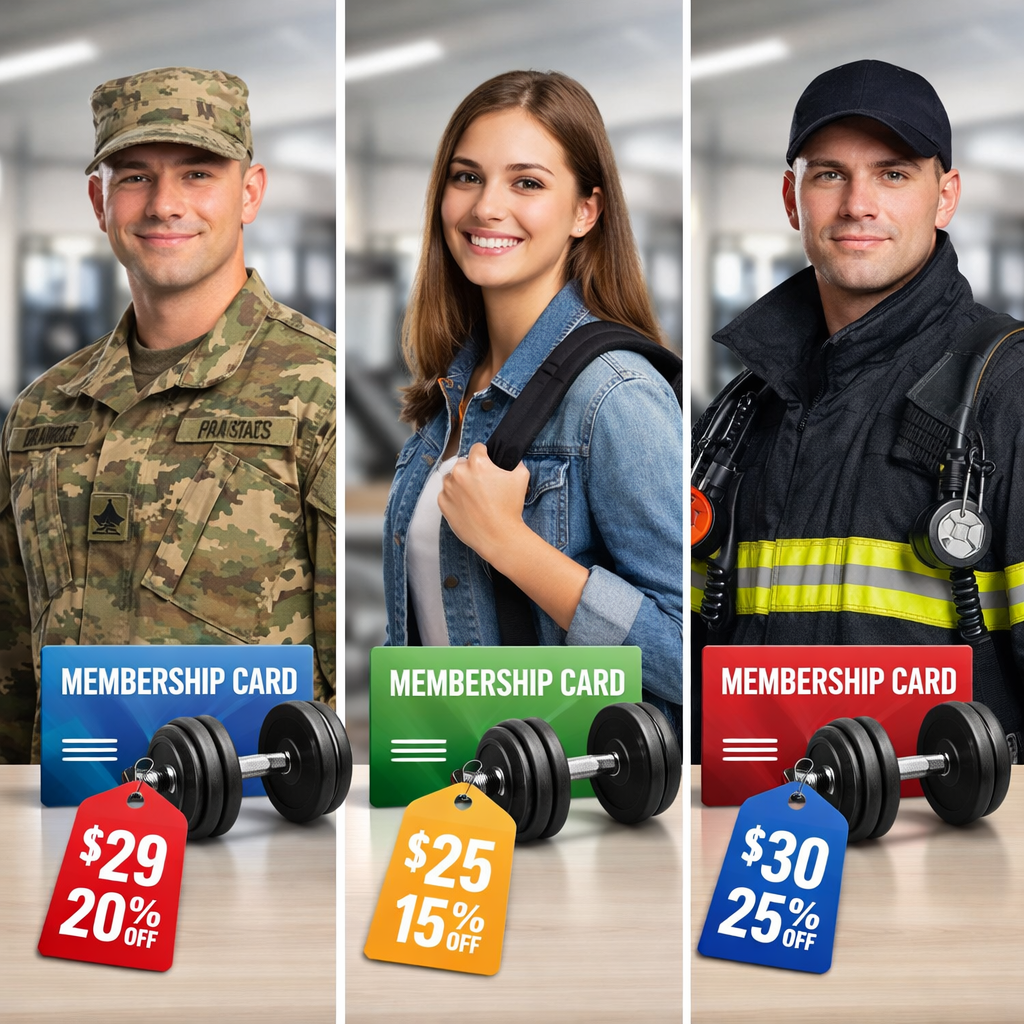
Compare Health Club Deals: Military, Student, First-Responder Savings Explained
Looking for health club discounts for military, students, and first responders? Many national and regional gyms offer reduced rates, fee waivers, and perks—but eligibility, verification, and contract terms vary by location. This guide shows who typically qualifies, how ID verification for gym discounts works, and how to judge real value using FitnessJudge’s four-step decision framework. We also connect military conditioning to the Canadian Armed Forces’ FORCE Evaluation standards and flag where evidence is strongest. Before you sign, learn how to compare total cost of ownership and pressure-test the fine print so your “discount” doesn’t become the most expensive option.
How to use FitnessJudge’s comparison framework
Total cost of ownership (TCO) for a gym membership is the all-in spend over your planned term, including enrollment fees, monthly dues, add-ons (classes, towel service), required verification costs, and cancellation penalties. TCO helps compare “cheap” rates that may hide fees.
Contract terms are the rules that govern your membership—length, cancellation windows, freeze options, relocation/deployment clauses, re-verification cadence, and any penalties—determining your flexibility and true cost. FitnessJudge prioritizes clear TCO math and contract risk so different offers can be compared apples-to-apples.
FitnessJudge’s four-step method:
- Set goals: Train for an occupational fitness test vs. general wellness.
- Compare value: Local vs. network access, equipment fit, bundled perks.
- Scrutinize terms: Commitments, cancellation, freeze fees, re-verification frequency.
- Track results: Cost per month, visits, and progress toward goals.
Checklist to standardize choices:
| Criteria | What to look for | Why it matters |
|---|---|---|
| Eligibility | Accepted IDs, portal process, dependent coverage | Prevents onboarding delays and surprise denials |
| Savings | % off dues, fee waivers, stackable rewards | Separates headline discounts from real cash savings |
| Facility fit | Equipment/space for your training tasks | Ensures the gym supports your measurable goals |
| Terms | Contract length, cancellation, freeze, relocation | Limits risk if life or work changes |
| Tracking | Cost/visit, attendance, progress markers | Confirms the discount delivers results over time |
Who qualifies and how verification works
Discounts are usually contingent on verified status. Most clubs verify in person (showing service/employment ID or student ID) or via an online verification portal that confirms your eligibility with an ID scan or institutional email. Annual re-verification is common; call the local club to confirm the process and timing.
Evidence from preferred-pricing programs explicitly includes Canadian military and first responders and requires proof of service to access discounts, underscoring the verification-first model used broadly across perks programs (see this preferred responder pricing precedent: preferred-pricing programs).
“Preferred pricing” is a special rate reserved for defined groups (e.g., military, first responders) that requires proof of eligibility. It may include discounted dues, waived fees, or bundled perks and can differ by location, contract length, and participation rules.
A “verification portal” is an online gate that checks your status—often via official ID upload, employer or .edu email, or a third-party ID check—before unlocking a group-specific rate. Expect one-time enrollment verification plus periodic re-checks (often annually) to keep discounted pricing active.
Key evaluation criteria for discounted memberships
- Eligibility and proof: Which IDs are accepted? Do dependents qualify? How often must you re-verify?
- Savings profile: Percent off monthly dues, waived enrollment, guest privileges, and any rewards or bundled perks.
- Facility fit: Equipment and space for your training tasks (e.g., turf, sleds, sandbags, sprint lanes).
- Terms: Contract length, cancellation windows, freeze fees, relocation/deployment clauses, blackout restrictions.
- Compute annual savings and TCO under best/worst usage (e.g., 12 visits/month vs. 3 visits/month).
Military discounts
Eligibility and proof of service
Most clubs extend discounts to active duty, reserve, veterans, and sometimes spouses/dependents, contingent on proof of service. Preferred-pricing models explicitly include the Canadian military and require proof to access discounted rates, mirroring the verification-first approach common in gym discounts (preferred-pricing programs). CF One is a membership card/program for Canadian Armed Forces communities that provides exclusive discounts, rewards, and access to personalized financial, fitness, and wellness programs that may stack with base or commercial facility offerings; see FORCE Evaluation for context (FORCE Evaluation). Ask whether dependents are included and if annual re-verification is required.
Typical savings and what’s included
Expect a monthly percentage discount plus possible waived enrollment fees. Track:
- Percent off dues and any time limits
- Waived enrollment/processing fees
- Guest privileges and family add-ons
- Access to multi-club networks or nationwide tiers Layered programs—such as CF One perks plus club promotions—can increase effective savings, but specifics vary by chain and location.
Training alignment and facility fit
The FORCE Evaluation is the Canadian Armed Forces’ minimum physical employment standard under Universality of Service, built from six common military tasks and timed/repetition benchmarks that assess operational readiness across shuttles, lifts, carries, drags, and fortification activities (FORCE Evaluation details). Benchmarks include:
- 20-m rushes: two shuttle sprints with prone drops in 51 seconds or less
- Sandbag lift: 30 lifts of a 20 kg sandbag to 1.0 m in 3:30 or less
- Intermittent loaded shuttles: 10 shuttles totaling 400 m (alternating 20 kg carry), in 5:21 or less
- Sandbag drag: carry one 20 kg and pull at least four along the floor for 20 m without stopping Match facilities to tasks: turf lanes, sandbags, sleds, weighted carries, functional rigs, and space for shuttles and prone transitions.
Contract terms and fine print to check
Confirm deployment and relocation clauses, early-cancellation fees, and hold/freeze policies for temporary duty. Verify whether rewards programs like the FORCE Rewards program—recognizing high health-related fitness—require activity at specific facilities or can be pursued anywhere (FORCE Rewards program). Mini-checklist:
- Re-verification cycles and required documents
- Family add-on pricing and access rights
- Multi-location access during training/PCS
First-responder discounts
Eligibility and proof of employment
Typical coverage includes police, fire, and EMS; some clubs may include dispatchers or healthcare workers. Preferred-pricing precedents explicitly added first responders, reinforcing that verified employment is required before discounts apply (preferred-pricing programs). Ask which IDs are accepted (agency ID, pay stub) and whether an online verification portal is available. Keep digital scans for swift enrollment and call ahead to confirm that a specific location participates.
Typical savings and what’s included
Document:
- Monthly percent off and any initiation fee waiver
- Access to premium equipment or small-group training
- Peak-hour restrictions or exclusions from higher-tier clubs
- Family plans and free trials before commitment
Facility features that support responder fitness
Look for job-relevant conditioning tools: sleds, farmer’s carry implements, stair climbers, battle ropes, sprint lanes, and mobility areas for injury prevention. Prioritize programming alignment (circuit-based conditioning, duty-specific workshops) and adequate floor space for shuttles, carries, and drags. Quick capability checklist: loaded carries, drags, sprint lanes, stair work, and recovery tools.
Contract terms and fine print to check
Shift work demands flexibility. Compare month-to-month vs. annual terms, freeze policies for injury or overtime cycles, and multi-location access across districts. Confirm re-verification cadence and penalties if job status changes. Get any verbal promises (e.g., waived fees) in writing on the agreement.
Student discounts
Be aware: the supplied sources did not include student-specific examples. The guidance below reflects common market practices; verify details locally.
Eligibility and proof of enrollment
Use a valid student ID, .edu email, or an enrollment letter. Confirm age caps (often 18–24) and full-time vs. part-time rules. Ask if alumni within a grace period qualify. Note differences for summer/winter access and whether re-verification is per term or annually.
Typical savings and what’s included
Look for 10–30% off and fee waivers at semester start, plus orientation-week trials. Validate inclusions:
- Study-friendly amenities (Wi-Fi lounges), quiet hours
- Access to premium classes (included or discounted)
- Locker/towel fees and guest privileges Compare total semester costs against campus rec center rates and nearby commercial chains.
Campus partnerships and academic-term timing
Check for university–gym partnerships or student services subsidies. Align start dates to maximize months used; consider short-term passes during finals or breaks. If studying abroad or on co-op, confirm reciprocity or pause options.
Contract terms and fine print to check
Prefer contracts with easy cancellation at graduation/relocation, low freeze fees during breaks, and transparent add-on charges. Watch auto-renewal dates and notice windows to avoid rollover charges. Choose month-to-month if internships may shift locations.
Side-by-side comparison by criteria
| Criteria | Military | First Responder | Student |
|---|---|---|---|
| Eligibility & Verification | Service ID or portal; dependents sometimes included; re-verify annually; CF One may stack. Evidence: preferred-pricing models require proof. | Agency ID or portal; scope varies (police, fire, EMS); annual re-verification common. Evidence: preferred-pricing requires proof. | Student ID/.edu or enrollment letter; term-based re-verification; age/status caps common. |
| Savings & Stackability | % off + possible fee waivers; may layer with CF One and promos (location-dependent). | % off dues; initiation waivers; check peak-hour or tier exclusions. | 10–30% off; semester waivers/trials; campus partnerships may beat chain rates. |
| Facility Fit | Align to FORCE tasks—shuttles, sandbags, drags; turf, sleds, carries, space to sprint. Evidence: FORCE standards. | Carries, drags, stairs, HIIT circuits; mobility/prehab zones. | Convenience, flexible hours, study amenities; basic strength/cardio mix. |
| Terms & TCO | Deployment/relocation clauses; freeze policies; documented rewards participation. | Month-to-month flexibility; injury freezes; multi-location access across districts. | Easy cancellation at term end; low freeze fees; guard against auto-renew. |
Evidence notes: military/first-responder verification aligns with preferred-pricing proof requirements; military training alignment ties to the FORCE Evaluation standards.
Evidence gaps: student program specifics were not in the supplied dataset—confirm locally.
Eligibility and verification steps
- Military: Present service ID in person or use the club’s verification portal; ask if spouses/dependents qualify; note annual re-verification. Capture written confirmation of rate and fee waivers.
- First responder: Provide agency ID or complete portal verification; confirm inclusion of dispatchers or healthcare staff; record re-verification cadence and any exclusions in writing.
- Student: Verify via student ID or .edu email; clarify full-time status requirements and age caps; document per-term vs. annual re-verification.
Savings magnitude and stackability
- List percent off dues, waived enrollment, and any rewards (e.g., CF One perks referenced alongside FORCE resources).
- Stacking with promo rates is often limited; get any combined offer (service discount + referral credit or fee waiver) in writing.
Facility fit to goals and training needs
- Military: Map needs to FORCE tasks—shuttles, sandbag lifts/drags—and confirm turf lanes, sandbags, sleds, and carry space.
- First responder: Prioritize loaded carries, sprints, stair work, circuit space, and recovery tools.
- Student: Emphasize proximity, hours, and quiet zones that support academic schedules.
Contract flexibility and total cost of ownership
Score each option (1–5) on contract length, cancellation ease, freeze cost, multi-location access, and re-verification burden.
Example TCO: Enrollment ($99) + 12 months dues ($45 × 12 = $540) + add-ons ($10 × 12 = $120) − waived fees ($99) = $660 for the year. Recalculate for best/worst usage (e.g., cost/visit).
Local versus network access value
- Choose local-only if you rarely travel or rotate sites; lower dues can beat network access you won’t use.
- Choose network access if you train across cities, districts, deployments, co-ops, or study abroad.
- Compare your travel patterns, reciprocity agreements, blackout dates, and club tier restrictions before assuming nationwide access.
How to pressure-test terms before you join
- Ask for a one-page membership summary: base dues, discount line, enrollment/admin fees, add-ons, and contract length.
- Confirm cancellation window, freeze policy/fees, relocation/deployment clauses, and re-verification cadence and costs.
- Get fee waivers and special rates in writing on the agreement; screenshot portal approvals.
- Red flags: verbal-only promises, high admin fees, 45–60 day notice windows, discounts tied only to premium upgrades.
- Take a 24-hour cooling-off period; recompute TCO under both high-use and low-use scenarios.
Actionable next steps and decision checklist
- Define your primary goal (e.g., pass an occupational test, rebuild baseline fitness).
- Shortlist 3 gyms within your commute.
- Verify eligibility and re-verification cadence.
- Test facility fit with a day pass during your typical workout time.
- Request written terms and all fee waivers.
- Compute TCO and cost/visit scenarios.
- Set a 90-day results tracker.
Bring: government/agency/student ID, proof of status/enrollment, payment method, and your questions list.
Track KPIs: visits per week, cost per visit, progress markers (e.g., shuttle time, lift reps), and monthly spend vs. plan.
Frequently asked questions
How do I verify eligibility for military, student, or first-responder discounts?
Bring official ID to the front desk or use the gym’s online verification portal. FitnessJudge recommends confirming accepted documents, dependent coverage, and annual re-verification.
Can I combine a service discount with a promotional rate or referral credit?
Stacking is uncommon, but some locations will apply a referral credit or waive fees alongside a service discount; get it in writing. FitnessJudge’s rule: don’t assume stackability without documented approval.
Do all locations of a gym honor these discounts?
No—participation varies by franchise and region. Call your target location for the exact rate and fee waivers, and keep written confirmation.
What contract clauses matter most with discounted memberships?
Focus on cancellation terms, freeze policies, re-verification requirements, and relocation or deployment clauses. These determine real flexibility and total cost.
How much can I realistically save in a year with these discounts?
Savings vary by gym and location, but many members save a waived enrollment fee plus a monthly percentage off dues. FitnessJudge advises calculating 12 months of dues minus waived fees for a clear estimate.