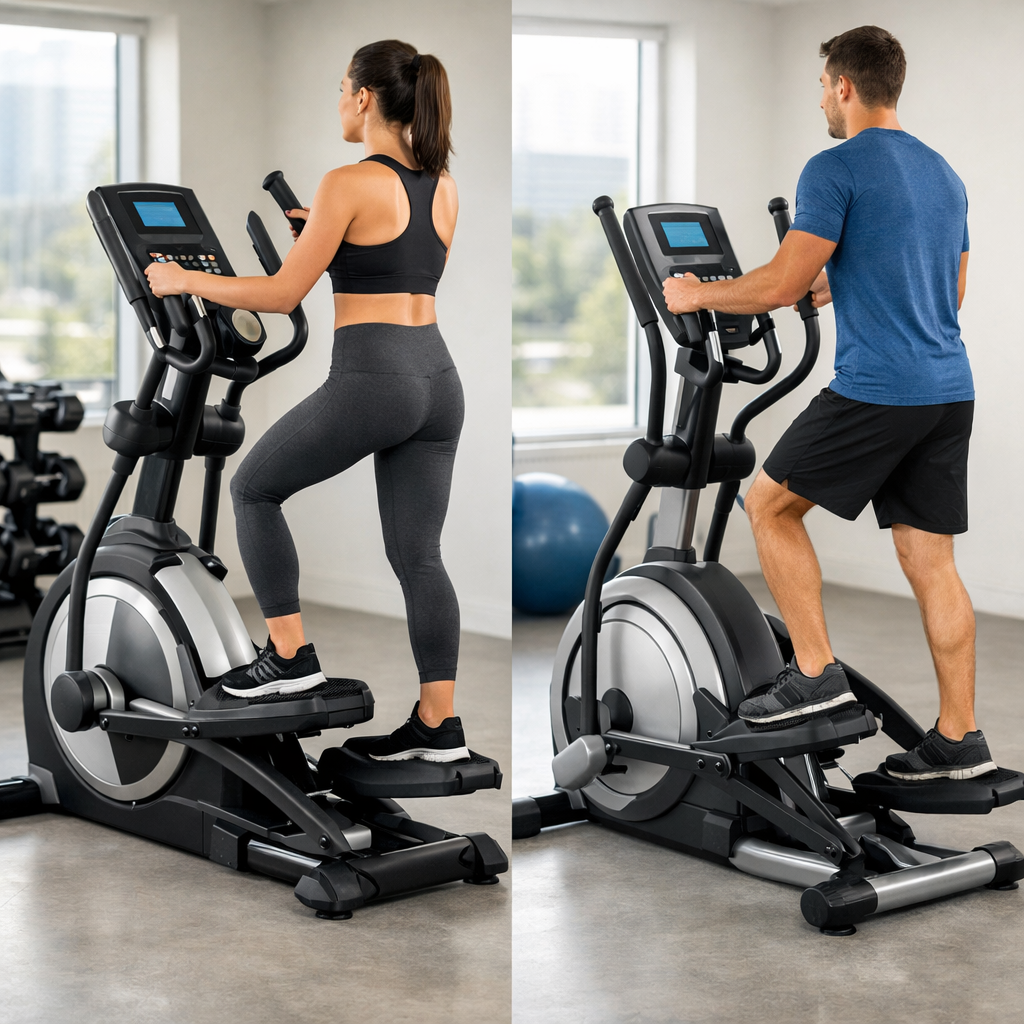
Find Your Best Elliptical: Front- vs Rear-Drive Pros and Cons
Choosing between a front-drive elliptical and a rear-drive elliptical comes down to how you train, the space you have, and the “feel” you prefer. Are front-drive or rear-drive ellipticals better? For compact, budget-friendly home gym cardio and predictable daily use, front-drive is often the smarter fit. For a smoother, more natural elliptical stride and heavier-duty use, rear-drive usually wins. Below, we translate drive placement into real-world outcomes—covering footprint, stride feel, flywheel weight, maintenance, noise, cost, and app compatibility—so you can pick confidently, even if you’re buying an elliptical for small spaces. This FitnessJudge guide focuses on what you’ll feel, maintain, and spend over time.
Quick answer to the front vs rear question
It depends. Front-drive is typically better for lower cost, compact footprint, and predictable day‑to‑day cardio. Rear-drive is typically better for smoother, balanced stride mechanics and heavier-duty training. Think of it like cars: FWD emphasizes packaging and cost efficiency, while RWD emphasizes balance, performance, and durability, per automotive comparisons of FWD vs RWD and service traits (FWD vs RWD overview, repair and cost differences, balance advantages).
- Choose front-drive if you want lower cost and smaller footprint.
- Choose rear-drive if you want a more natural, performance-oriented stride and plan intense or frequent training.
“Drive type (front-drive vs rear-drive) refers to where the elliptical’s flywheel and transmission sit—ahead of or behind the pedals. Placement changes mass distribution, mechanical complexity, footprint, and the ‘feel’ of the stride.”
How drive location works
Front-drive places the main mass and transmission at the front of the frame, similar to how FWD cars cluster components for space and cost efficiency. This packaging can shorten overall length and simplify assembly and service compared with some rear-drive designs, echoing FWD’s practical packaging benefits and production economies.
Weight distribution (definition, ~50 words): Weight distribution describes how a machine’s mass is spread from front to back. A front-heavy system can feel anchored at the nose during easy use, while a more rear-balanced system often feels even and smooth at higher effort—similar to the 50:50 balance often highlighted in RWD performance discussions.
Mechanical complexity varies. Front-drive systems are frequently simpler and cheaper to build and maintain, whereas rear-drive designs may add parts and length but can be engineered for higher loads and long-term robustness—paralleling how RWD layouts are favored for heavier service duty in vehicles.
Flywheel (definition, ~45 words): The flywheel is the rotating mass that stores and releases kinetic energy each stroke. Heavier flywheels generally smooth cadence changes and can feel more “inertial,” while lighter flywheels rely more on gearing and resistance controls. What matters is total system inertia and how it translates to smoothness at your pace.
Comparison criteria that matter
Evaluate models apples-to-apples using this quick checklist:
- Footprint and packaging efficiency: Dictates fit in tight rooms and apartments.
- Weight distribution and stability: Influences balance and perceived smoothness at speed.
- Mechanical complexity and service access: Affects reliability and maintenance costs.
- Stride feel and inertia: Determines natural gait vs predictable rhythm for your training.
- Noise and vibration: Important in shared spaces and upstairs units.
- Cost of ownership: Parts, labor, and downtime over years of use.
These are the same factors FitnessJudge weighs in reviews.
Side-by-side snapshot:
| Criteria | Front-drive | Rear-drive |
|---|---|---|
| Footprint | Shorter overall length; space-efficient front cluster | Longer due to rear housing/overhang |
| Stability | Planted nose; stable at steady paces | More balanced fore–aft feel at higher efforts |
| Stride feel | Predictable, step-like rhythm; good for steady cardio | Smoother, more natural gait; better at speed |
| Complexity | Often simpler; easier access/cheaper service | Can be more complex; service may cost more |
| Cost | Lower average purchase price | Higher average purchase price |
| Best for | Budgets, small spaces, family cardio | Performance feel, longer sessions, heavy use |
Front-drive ellipticals
Front-drive ellipticals prioritize packaging and value, much like FWD’s space efficiency and lower production costs. With the drivetrain up front, these machines usually take up less room and keep parts accessible. Many owners appreciate the predictable, steady feel for daily cardio and multi-user households. In FitnessJudge reviews, well-built front-drive units often lead on value and setup ease.
Pros:
- Smaller footprint and easier room fit thanks to concentrated components.
- Lower upfront price and simpler routine maintenance.
- Predictable, stable feel at low-to-moderate intensities.
Cons:
- Less “natural,” long-stride dynamics at higher speeds or for taller users.
- May struggle to deliver high inertia and ultra-smooth feel versus robust rear-drive builds.
Rear-drive ellipticals
Rear-drive machines lean into balance and stride quality, echoing RWD’s even weight distribution and performance favorability. By moving mass rearward, these units often feel smoother at faster cadences and can be built for heavier duty cycles, making them a solid pick for serious training. Our reviews consistently note their stride quality at faster cadences.
Pros:
- Smoother, more natural pedal path and balanced feel at higher effort.
- Often more robust frames and components that tolerate heavier use.
Cons:
- Typically longer overall length because of the rear housing.
- Higher purchase price and potentially more complex servicing.
Side-by-side: pros and cons
| Front-drive | Rear-drive | |
|---|---|---|
| Pros | Compact; cost-effective; simple upkeep; predictable feel | Balanced; smoother, outdoor-like gait; performance-oriented |
| Cons | Less natural at long strides; less inertia at max efforts | Larger footprint; higher price; service can be more involved |
Biomechanics and stride feel
Stride length (definition, ~45 words): Stride length is the front-to-back distance your feet travel in one full cycle. Longer strides better mimic outdoor walking or jogging and tend to suit taller users. Shorter strides feel more step-like and compact, which can be comfortable for smaller bodies and lower intensities.
Rear-drive often delivers a smoother, outdoor-like gait at jogging cadences—akin to RWD’s sharper dynamics and balanced steering feel—while front-drive commonly produces a stable, step-like rhythm that shines for steady, predictable cardio.
Mini checklist:
- Prefer outdoor-like jogging feel → consider rear-drive.
- Prefer upright, step-like cardio and simple rhythm → consider front-drive.
FitnessJudge prioritizes fit and stride feel first in any pick.
Space, setup, and noise
Front-drive’s clustered components generally reduce overall length, helpful in tight rooms, while rear-drive needs a rear overhang that increases length. Measure carefully, especially in apartments and around doors.
Actionable setup steps:
- Measure usable floor length and ceiling clearance; add 12–18 inches behind rear-drive units for mount/dismount space.
- Use a dense vibration mat and adjust levelers to reduce transfer noise on upper floors.
- Route power cords safely to avoid pedal interference.
Footprint (definition, ~50 words): Footprint is the floor area a machine occupies, measured in length and width. It dictates where a unit can be placed, how safely you can mount and dismount, clearance around walls or furniture, and whether it will pass through doorways—critical considerations for apartments and compact home gyms.
Durability, maintenance, and cost of ownership
Simpler front-drive mechanisms can reduce ongoing maintenance costs, mirroring how FWD designs are cheaper to build and repair. Rear-drive machines are frequently engineered for heavier-duty workloads, much like RWD’s suitability for higher loads—advantageous for frequent, intense training or multi-user homes. FitnessJudge also scores models on long-run parts access and ease of service.
Maintenance checklist:
- Inspect rails/rollers and linkages monthly; keep tracks clean of debris.
- Tighten hardware quarterly; follow belt/tension and bearing service intervals.
- Budget annually for wear items (rollers, belts, pedals) and lubrication.
Training goals and user fit
- General fitness, steady-state, family use: Front-drive for predictable feel, value, and compact size.
- Performance intervals, longer sessions, taller users: Rear-drive for smoother stride mechanics and longer, more natural elliptical stride options.
- Heavy users or frequent multi-user setups: Lean rear-drive for robustness; if space/budget are tight, pick a well-built front-drive with a strong warranty.
Quick fit cues: Prefer outdoor-like gait or longer strides? Prioritize rear-drive. Need lower cost, smaller footprint, and simple operation? Prioritize front-drive.
Price tiers and value
- Entry ($): Front-drive typically offers the best value—compact, budget-friendly, with acceptable stride feel for steady cardio.
- Mid ($$): Either drive can work. Compare stride length options, flywheel system inertia, adjustability, and warranty depth.
- Premium ($$$): Rear-drive is common for refined feel, balance, and durability. Confirm service access and parts availability to protect your investment.
Remember: simpler systems can reduce long-run spend, while robust builds minimize downtime under heavy loads. FitnessJudge also prioritizes parts availability and in‑home service.
App and platform compatibility
Check specs for ecosystem fit before you buy:
- Platforms: Look for native or pass-through support to Apple Health, Garmin, Strava, and popular training apps; note Peloton app integration and whether ANT+ or Bluetooth FTMS is supported.
- Data fields to expect: Cadence (RPM), speed, distance, calories, heart rate pass-through; some smart models allow limited third-party control of resistance.
Our recommendation framework
Step-by-step decision flow:
- Space and ceiling clearance → shortlist drive types (front-drive if tight).
- Training style and user size → prioritize stride feel (rear-drive for natural gait/longer strides).
- Budget and maintenance tolerance → weigh simplicity vs robustness.
- Noise and app needs → confirm ecosystem and connectivity fit.
Scoring dimensions we use at FitnessJudge: Biomechanics/fit, Build quality, Features, Reliability, Warranty, Cost of ownership, and User experience (setup, noise, footprint, app support).
Balanced takeaway: There isn’t a universal “best” layout—choose based on intended use and environment, just as drivers match drivetrains to conditions and priorities in vehicles (see Consumer Reports’ drivetrain matching guidance: 2WD vs AWD vs 4WD explainer).
Frequently asked questions
Do front-drive or rear-drive ellipticals feel more natural for running and walking?
Rear-drive usually feels more natural at jogging-like cadences; front-drive delivers a predictable, step-like rhythm. FitnessJudge recommends trying both if possible, since stride feel varies by design and your height.
Which drive type is better for small spaces or apartments?
Front-drive models typically have a shorter footprint and simpler packaging for tight spaces. FitnessJudge also recommends a quality mat to reduce vibration and protect floors.
What drive type is best for heavier users or high-intensity training?
Rear-drive designs often handle heavier use and stay balanced at high intensity. If space or budget is tight, FitnessJudge suggests a sturdy front-drive with a strong warranty.
Are rear-drive ellipticals always more durable than front-drive?
No—build quality and maintenance matter more than drive type. FitnessJudge advises comparing frame construction, parts availability, and service access.
Should I prioritize flywheel weight, stride length, or drive type when buying?
Start with stride length and overall fit, then consider drive type for feel and footprint, with flywheel weight as a supporting spec. That’s the FitnessJudge order of operations.