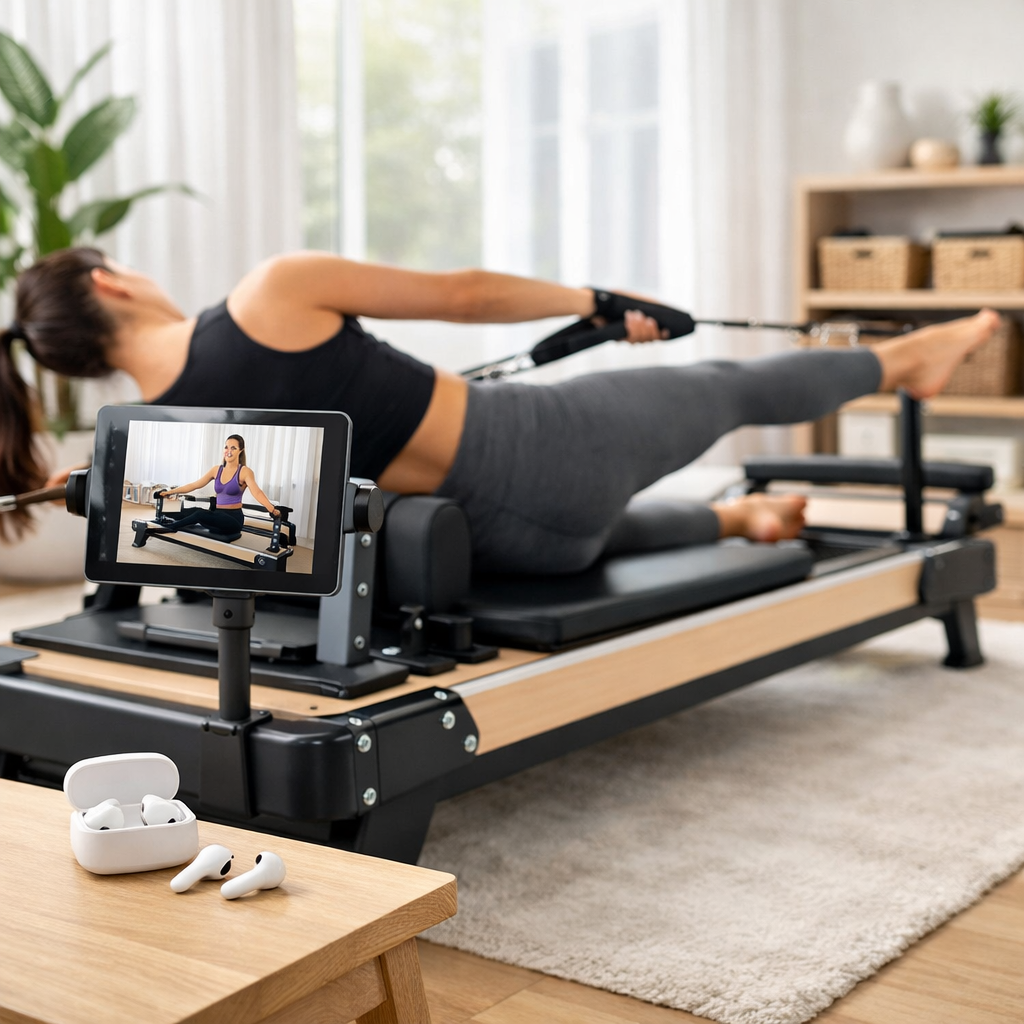
How to Choose a Connected Pilates Reformer With App Classes
A connected Pilates reformer blends studio-grade mechanics with an app-driven training platform so you can stream instructor-led classes, track progress, and personalize workouts at home. If you’re asking which reformers include connected or app-based training, standouts include fully integrated systems like the NordicTrack Ultra 1 with a built-in touchscreen and electronic resistance, and commercial-grade entrants like Reform RX with movement tracking and on-demand classes. Many contemporary models also support a bring-your-own-tablet setup paired with third‑party apps. This FitnessJudge guide shows you how to match goals and budget, measure your space, judge frame quality and resistance, and compare app ecosystems, subscriptions, and total ownership cost—so you can pick the best connected Pilates reformer with app classes for your home or studio.
Define goals and budget
Start with why you’re buying. If your primary goal is skill-building with structured, instructor-led Pilates, prioritize platforms with deep class libraries, clear coaching cues, and progress plans. For low-impact rehab or return-to-movement, look for smooth carriage action, supportive headrest/shoulder blocks, and precise spring or electronic micro-adjustments. If you want higher-intensity cardio and plyometric work, ensure jumpboard compatibility and sturdy frame stability.
Set a realistic budget that includes ongoing content. Consumer testing outlets note many connected platforms charge a separate monthly fee for their app classes and tracking, which should be factored alongside the machine purchase (see Good Housekeeping’s best reformers guide). Pricing tiers often break down as:
- Tablet-holder, app-optional home models: lower upfront cost, BYO screen, modest subscription.
- Integrated-screen, app-required systems: higher hardware price, premium content and analytics, higher subscription.
- Commercial-grade connected machines: studio durability and advanced metrics, priced accordingly.
Plan your budget for the reformer, delivery/setup, accessories (box, jumpboard, mat), and a monthly membership if you want a reformer with classes from a connected platform.
Measure space, placement, and delivery needs
Connected reformers are longer and heavier than minimalist home units. For example, the NordicTrack Ultra 1 measures about 112.5" L x 27.5" W x 15.5" H and recommends roughly 19 inches of clearance around it in an official overview video. Long wheelbases ride beautifully, but they demand real estate and thoughtful placement.
Before you order:
- Map access: measure doorways, hallways, and the final room; confirm the floor can support the load; consider white‑glove delivery for heavy machines to avoid setup headaches (Women’s Health’s buyer’s guide stresses these logistics).
- Do a 3-step space check:
- Map the footprint plus an 18–24" perimeter for safe movement and coaching prompts.
- Ensure ceiling height supports standing work and overhead arm lines.
- Confirm storage options (folding frames, wall mounts, or transport wheels) fit your home.
Verify frame quality, safety, and warranty
A Pilates reformer is a padded table with a sliding carriage, springs, ropes, pulleys, and a footbar designed to add adjustable resistance to full‑body movements for core strength and mobility.
Prioritize commercial-grade frames with stable platforms, a clearly stated weight capacity, and a strong reformer warranty—ideally lifetime or otherwise competitive on the frame—to protect your long-term investment, as independent testing roundups—and our evaluations at FitnessJudge—emphasize. Safety-critical details matter:
- Secure, easy-to-adjust footbar lock
- Quality carriage wheels/rollers for smooth glide
- Non-slip standing platform and durable, padded straps
- Clear maintenance instructions and accessible customer support
Choose resistance type and adjustability
Traditional spring systems are the backbone of classical reformers, offering consistent resistance and familiar “feel” for experienced users. Contemporary reformers often vary spring resistance options for more nuanced progression and beginner friendliness (Women’s Health compares these approaches). High-end connected models may add electronic resistance for quick, precise, in-session changes and metric-driven progressions. In one product demo, Ultra 1 shows electronic resistance adjustment across roughly 22–143 lb, enabling app-controlled shifts during classes.
For versatility with app guidance, look for:
- Multiple footbar positions (securely locking)
- Adjustable headrest and shoulder blocks
- Variable pulley height and rope length
- Clear spring or resistance labeling for class cues
Evaluate the app ecosystem and connectivity
Class library, instruction quality, and coaching features
FitnessJudge prioritizes clear coaching, stable connectivity, and transparent pricing when we evaluate connected platforms. Integrated-screen platforms deliver a cinematic, all-in-one experience; tablet-holder systems can be more flexible and budget-friendly but depend on app selection and your device. Many connected reformers include guided classes but require an additional monthly fee, which should be factored into value (Good Housekeeping’s editors flag this frequently). Reform RX, for example, couples a commercial-grade connected reformer with on-demand classes and sensor-led precision that tracks movement down to the thousandth of a second for granular feedback.
Use this quick comparison table when evaluating platforms:
| Platform type (example) | Class formats and depth | Coaching prompts in class | Sensor/camera feedback | Structured progress plans | Offline download |
|---|---|---|---|---|---|
| Integrated screen, electronic resistance (e.g., Ultra 1–style) | Beginner series, themed blocks, live/on‑demand | Real-time cues for resistance, footbar, safety | Basic metrics; may add rep/time | Often built-in programs | Sometimes |
| Commercial-grade connected (e.g., Reform RX) | Studio-style on-demand library | Detailed setup/resistance cues | Advanced tracking precision | Progressive tracks by level | Varies |
| Tablet-holder + third‑party app | Varied (depends on app used) | App-led cues; manual setup | Limited to wearable data | Some apps offer programs | Often |
Device integration, heart-rate and wearable compatibility
Connected fitness means hardware and software integrate to stream classes, record workout metrics, and sync with wearables—often via a paid subscription. Verify whether your device works before you buy. In one Ultra 1 overview, the unit connects with Apple, Polar, and Whoop, while Garmin isn’t yet supported—so double-check compatibility in advance. For a Bluetooth Pilates reformer, confirm:
- Bluetooth or ANT+ support and HR broadcast pairing
- Data sync to Apple Health or Google Fit
- Stable connections for chest straps and watches
- Export options if you track training elsewhere
Profiles, household sharing, and data privacy controls
Multi-user support determines household value. As a benchmark, some on-demand platforms allow up to five profiles on a membership at around $25/month, which can lower cost per user (as flagged by mainstream testing roundups). Review privacy and controls before subscribing:
- Separate adult/child profiles and PIN locks
- Individual recommendations and history
- Clear marketing opt-outs and data deletion/export tools
- Visibility controls for shared devices and leaderboards
Subscription model, trials, and cancellation terms
Confirm whether a membership is required for full functionality—some touchscreen systems are limited without an active plan and may cost about $39 per month. Look for free trials, pause options, and transparent month-to-month vs annual discounts. To compare platforms fairly, calculate 3-year scenarios (hardware + subscription + accessories + delivery/setup) and choose what you’ll realistically use.
Assess usability, noise, and maintenance
Daily feel matters. Check editor testing and user reports on carriage smoothness, noise, and instruction quality; independent reviews highlight these differences clearly (Verywell Fit and Good Housekeeping both compile hands-on impressions, while Marie Claire’s at‑home review adds real-world perspective). Basic upkeep will extend lifespan and preserve quiet operation:
- Wipe sweat after sessions; avoid harsh chemicals on upholstery
- Inspect straps, ropes, and springs periodically; replace worn parts
- Follow brand cleaning and lubrication guidance
Remember: a moving carriage encourages deep core engagement and spinal alignment; smooth mechanics should support posture and joint comfort during dynamic sequences (a point echoed in consumer guides comparing classical and contemporary builds).
Compare total ownership cost
Use this template to avoid surprises:
- Hardware price
- Shipping/delivery and optional white-glove setup
- Required subscription
- Accessories (box, jumpboard, mat)
- Maintenance (spring replacements, periodic parts)
- Extended warranty
Illustrative 1–3 year totals (example estimates; actual brand pricing varies):
| Scenario | 12-month total | 24-month total | 36-month total |
|---|---|---|---|
| Integrated screen + required subscription | $5,017 | $5,535 | $6,053 |
| Tablet-holder + third‑party app | $2,899 | $3,249 | $3,599 |
Assumptions: Integrated-screen setup includes a $3,499 machine, delivery/setup, accessories, and a $39/mo membership; tablet-holder setup includes a $1,999 machine and a $25/mo app. Maintenance is minimal in year one and modest thereafter. For a deeper framework, see our standardized equipment evaluations on FitnessJudge’s gym equipment hub.
Demo and validate with real-world reviews
Reduce risk with hands-on exposure. Try an in-person demo or studio session, or watch full-length brand walkthroughs to evaluate carriage feel, noise, and class quality. Cross-check impressions against independent test outlets that compare multiple machines, noting methodology and long-term updates (Verywell Fit and Good Housekeeping provide structured testing; Marie Claire offers consumer-use context). If you’re new to reformer Pilates, sample a few beginner studio lessons first to learn safe setups and form.
Home versus studio requirements
Studios need software that keeps classes full and operations smooth. Must‑have features include class scheduling with recurring options, app-based booking, automated payments and billing, waitlists and spot-swapping, staff/client management, real-time reporting, marketing tools, and integrations with payroll/POS (a studio platform checklist compiled by Fold Reformer outlines these needs). Commercial-grade connected options that support on-demand classes for groups—like Reform RX’s commercial offerings—can bolster programming and uptime.
For home users, prioritize space fit, lower noise, app quality, and simple maintenance. For studios, emphasize durability, easy sanitization, uptime, client retention tools in your booking app, and staff permissions/user management.
Frequently asked questions
What space and clearance do I need for a connected reformer?
Aim for a full-length footprint with 18–24" clearance on all sides; some large models specify roughly 19" around the machine. Verify dimensions before delivery, especially for longer connected units; see FitnessJudge’s buying guides for quick measuring steps.
How do I assess build quality and durability from specs?
Look for a robust frame with a clear weight capacity, smooth carriage hardware, and a strong warranty—ideally lifetime or competitive on the frame. FitnessJudge’s evaluations emphasize these as primary indicators of long-term safety and value.
Are electronic resistance systems better than traditional springs?
Electronic resistance enables quick, precise changes and program control, which benefits guided classes. Springs remain reliable, budget-friendly, and preferred by many purists; FitnessJudge recommends choosing based on how you train and progress.
What should I look for in app classes and tracking features?
Prioritize a deep class library, clear coaching cues for setup/resistance, and reliable device syncing. FitnessJudge prioritizes reliable syncing and clear in-class coaching in our reviews.
How much should I budget for subscriptions and ongoing costs?
Expect a monthly content fee on many connected platforms. Use the total cost template above from FitnessJudge to compare 1–3 year value, including accessories, maintenance, and delivery/setup.
Citations:
- Good Housekeeping’s best reformers guide highlights pricing and subscription notes.
- NordicTrack Ultra 1 product overview video provides dimensions, clearance, connectivity, and electronic resistance examples.
- Women’s Health compares spring systems and buying logistics.
- Reform RX details its commercial-grade connected platform and granular tracking.
- Verywell Fit compiles editor-tested reformer feedback.
- Marie Claire contributes at-home reformer review context.
- Fold Reformer outlines studio software essentials.