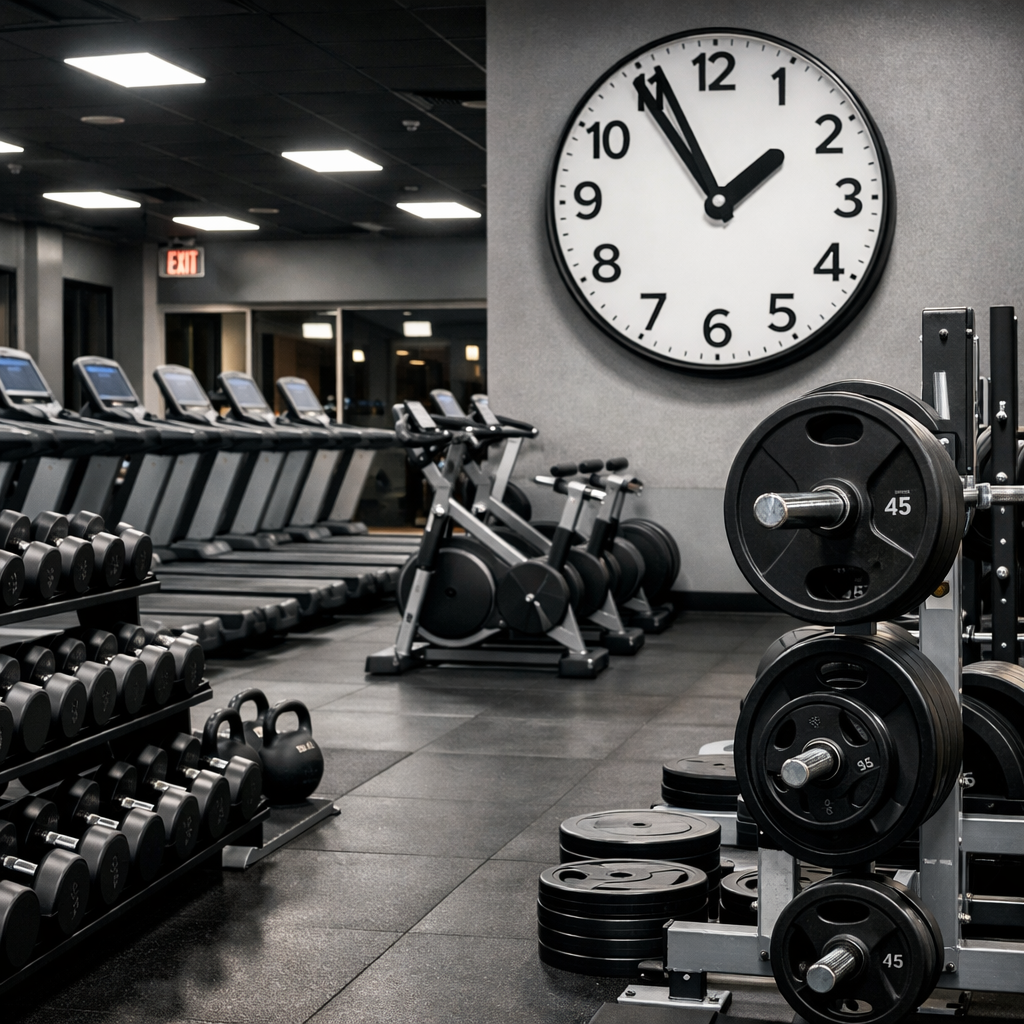
How to Find 24/7 Gyms With Free Weights and Cardio
Finding a 24-hour health club near me with free weights and cardio shouldn’t take all afternoon. Start with official gym finders and apps, filter for 24/7 access, then confirm there’s a full free weights gym setup and enough cardio machines for your peak times. Verify true after-hours entry (key fob access or Bluetooth), safety coverage, and clear staffed hours before you join. Finally, test the club at your actual workout time to check crowding, cleanliness, and vibe. Use the FitnessJudge checklist below to speed this process. This guide walks you through each step—fast—so you can join with confidence and train on your schedule.
What 24/7 really means
“24/7 gym access” is continuous entry to a facility via secure automation (RFID/Bluetooth readers and keycards), not full-time staffing. Expect member self-reliance overnight and posted emergency protocols for safety.
Most 24/7 gyms rely on automated doors, app or key fob entry, camera monitoring, and reduced overnight staffing; trainers and member services are typically available only during staffed hours, with self-guided or virtual options after-hours, according to anytime gym operations guidance from Elevate Fitness.
Brand and location policies vary. Some clubs advertise extended hours instead of true 24/7. Always check location-level pages and apps—for example, the official 24 Hour Fitness finder lists hours and amenities for each club.
Must-have free weights and cardio equipment
A reliable 24/7 gym supports progressive strength and conditioning without long waits. Confirm there are multiple racks or platforms, adjustable benches, Olympic bars, full dumbbell ranges, bumper plates, kettlebells, plus staple resistance machines. Look for a functional training zone and a dedicated stretching/mobility area so you can warm up, lift, and recover in one session. Elevate Fitness’ anytime training guide aligns with this equipment mix for round-the-clock usability.
Cardio breadth matters too. Expect rows of treadmills, ellipticals, rowers, and bikes; variety extras like stair climbers and spin bikes help you pivot when machines are busy.
Here’s a quick comparison matrix you can copy into your notes:
| Equipment category | Must-have items | Quantity check (per ~100 active members) | Notes |
|---|---|---|---|
| Racks & platforms | 2–4 power racks, 1–2 platforms | 2–3 racks minimum | Favor full cages over half racks for safety; look for bar storage and spotter arms. |
| Benches & bars | 4–6 adjustable benches; multiple Olympic bars | 1 bench per 15–20 users | Include at least 1–2 specialty bars (EZ curl, trap, or multi-grip) for variety. |
| Dumbbells & plates | Full set 5–100 lb (or higher); bumper and iron plates | 1 full dumbbell run | Check even increments and duplicates in mid-to-heavy ranges to reduce waits. |
| Kettlebells & accessories | KBs 8–32 kg+, bands, med balls | 1 full set | Verify open floor space for swings/carries; inspect handle condition. |
| Resistance machines | Pull-down, row, chest press, leg press/curl/extension | 6–10 total | Mixed brands are fine; prioritize smooth cables and consistent maintenance. |
| Cardio machines | Treadmills, bikes, ellipticals, rowers | 8–12 total | Add 1–2 stair climbers or spin bikes if possible for overflow. |
| Functional & recovery | Turf/functional zone; mats; straps; stretching area | Dedicated zone | Clear sightlines and posted etiquette help during off-peak hours. |
Safety, access, and staffing after hours
Verify visible access and safety markers: keycard/fob or app entry, camera coverage, emergency alert buttons, well-lit parking, and posted emergency procedures. Overnight sessions typically run without trainers; plan self-guided workouts or use virtual options during unstaffed times, as highlighted by Elevate Fitness.
Quick tip: Tell a friend your schedule and keep headphone volume low so you stay aware of your surroundings.
Step 1: Start with official gym finders and apps
Go straight to official websites and club apps for accurate hours, amenities, and location-specific notes. For a fast screen, use the FitnessJudge checklist below first. The official 24 Hour Fitness finder shows nearby clubs, staffed hours, and equipment highlights. The 24GO app also surfaces nearby clubs and class schedules; see this 24GO app guide for a quick overview.
Use filters and keywords: “24/7 access,” “free weights,” “power racks,” “rowers,” “functional zone,” and amenities like “HydroMassage” or “sauna” to spot complete facilities fast.
Step 2: Verify true 24/7 access systems
Look for clear tech signals: RFID or Bluetooth readers at the entrance, keycard/fob issuance during signup, and automated check-ins—all standard indicators of real round-the-clock access, as described in RFID and Bluetooth access control explainers. For example, GymMaster’s Bluetooth-based access control is widely adopted in the industry, with GymMaster adoption data noting use in 75+ countries.
Access control (concise definition): A combined hardware/software system that authenticates members—via RFID cards, key fobs, or Bluetooth app—to unlock doors, log entries, and trigger security protocols without on-site staff. Robust access control supports true 24/7 operation while recording who is in the club at any time.
Step 3: Audit photos, virtual tours, and equipment lists
Scan galleries and virtual tours to count racks and benches, confirm full dumbbell progression, spot platforms and bumper plates, and check for visible cardio rows (treadmills, rowers, bikes). Make sure a functional zone and stretching area are clearly marked for mobility and cooldowns—these are core features in anytime training guides like Elevate Fitness.
Cross-check the amenities page for group training, recovery tools, or premium features. Chains such as Workout Anytime often list location-specific perks like HydroMassage or sauna availability.
Quick scan list:
- Posted floor plan or map with zones labeled
- Explicit equipment counts (racks, benches, treadmills, rowers)
- Recent upgrade notes or maintenance logs
- Clear photos of access readers and entry vestibules
Step 4: Call member services to confirm details
Ask targeted questions:
- What are staffed hours vs. unstaffed times? When are trainers available, and what are rates?
- What’s the guest policy after-hours (some allow guests only during staffed windows or with preregistration)?
- How do emergency procedures work overnight? Are panic buttons and cameras monitored?
- What are the membership tiers and access rules (key fob or app fees, blackout periods, replacement costs, cancellation terms)?
Step 5: Test the gym at your actual workout time
Take a trial at the time you plan to train—very early or late—to judge:
- Crowd levels and wait times for racks and cardio
- Cleanliness, lighting, airflow, and equipment upkeep
- Entry reliability (door unlock speed, app/fob read)
Bring water, a towel, clean shoes, and your access credential for seamless entry. Where allowed, jot quick notes or take photos to capture equipment density and any out-of-service machines.
Step 6: Evaluate safety features and neighborhood
Walk the perimeter. Look for lighting in parking areas, visible cameras, blue-light/emergency buttons, and clear sightlines to entrances. Test the access system after-hours: verify your keycard/app opens doors promptly and that doors close and lock correctly behind you. As a habit, tell someone your schedule and keep volume low so you stay alert.
Weigh convenience, equipment variety, and cost
Boutique or hotel-style 24/7 spots often excel in convenience but may be light on heavy free weights, while larger chains or independent 24/7 clubs usually offer deeper strength sections—differences reflected in common types of gyms. Weigh total cost of access tech (key fob/app fees, replacements), guest rules, and any blackout periods against commute time and equipment breadth.
Simple decision matrix to score 1–5:
- Commute time
- Rack/platform count
- Cardio variety and availability
- Safety features (entry tech, cameras, lighting)
- Monthly price and fees
Use digital tools to plan and track workouts
Start with the FitnessJudge checklist to plan sessions and keep evaluations consistent. Use official gym apps for schedules, club maps, and membership management—apps like 24GO can surface nearby clubs and classes. Supplement off-peak sessions with on-demand yoga, Pilates, HIIT, and strength videos. For recovery and readiness, see wearables: a Whoop review notes 24/7 heart rate, blood-oxygen, and temperature tracking, but no built-in GPS unless paired with a phone.
Red flags to avoid
- Vague “open late” claims without explicit 24/7 systems (no mention of key fob/RFID/Bluetooth readers).
- Sparse or generic equipment lists that omit racks/platforms or show limited dumbbell ranges; no cardio variety stated.
- No photos or virtual tours, and no indication of cameras, emergency buttons, or parking lot lighting.
FitnessJudge checklist for 24/7 gyms
- Access and safety
- 24/7 keycard/fob or Bluetooth entry; camera coverage; emergency buttons; well-lit parking.
- Strength essentials
- Power racks/platforms, benches, Olympic bars, full dumbbell set, bumper plates, kettlebells, core resistance machines.
- Cardio lineup
- Treadmills, ellipticals, rowers, bikes; bonus variety: stair climbers or spin bikes.
- Space and recovery
- Functional training zone plus stretching/mobility area; optional recovery tools clearly listed.
- Operations
- Staffed hours posted; guest policy clear; app/portal for schedules and membership management.
Frequently asked questions
How do I quickly find 24/7 gyms near me with free weights and cardio?
Search official gym finders and apps first, filter for “24/7 access,” then confirm free-weight zones and cardio variety on each club page. Use the FitnessJudge checklist to streamline what you verify by phone before visiting.
What equipment should a solid 24/7 gym have for both strength and cardio?
Look for multiple racks, benches, Olympic bars, full dumbbell ranges, kettlebells, and key resistance machines, plus treadmills, rowers, ellipticals, and bikes. A functional zone and stretching area signal better programming options.
How can I confirm a gym is truly open and safe after hours?
Check for key fob/Bluetooth entry, cameras, emergency buttons, and posted overnight policies. The FitnessJudge checklist helps you cover these items quickly when you test entry at your intended time.
What membership terms and access rules should I ask about?
Ask about key fob/app fees, guest policy timing, blackout periods, staffed vs. unstaffed hours, and cancellation terms. Confirm replacement costs for lost credentials.
How do I verify quality before joining without committing?
Take a trial at your planned workout time to gauge crowding, cleanliness, and equipment maintenance. Review photos, virtual tours, and equipment lists, then call member services to fill gaps.