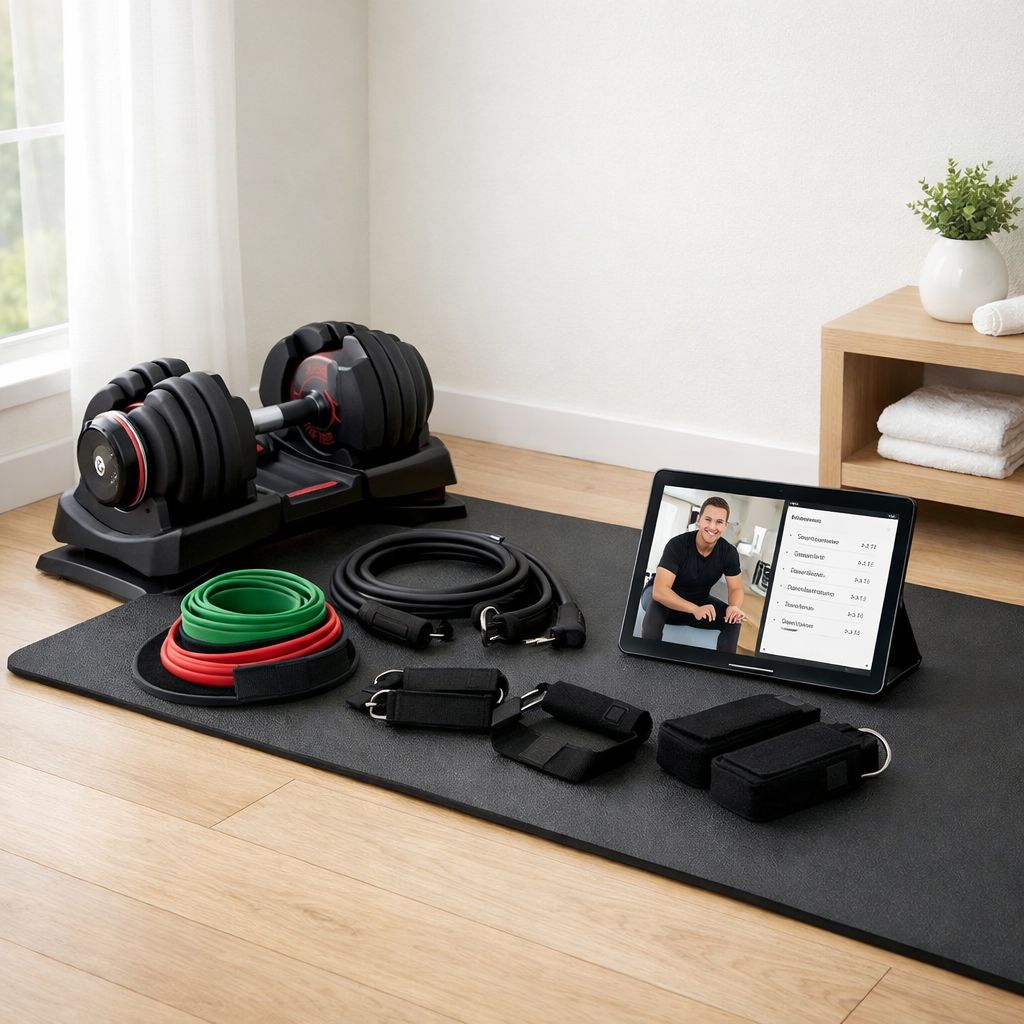
Skip the Guesswork: Home Gym Bundles That Include Coaching Memberships
Why coaching-integrated bundles solve home training uncertainty
If you’re asking which home gym equipment includes online trainer access, the short answer is: connected “smart” systems and coaching-enabled apps bundled with gear. Think cable-based smart units with live classes and form cues, compact dumbbell bundles that read your load, or racks paired with adaptive apps. These setups replace uncertainty with video demos, step-by-step guidance, and adaptive programming that tells you exactly what to do next, and how to do it safely, rep by rep (see this smart home gym roundup from Garage Gym Reviews for how these features work in practice). FitnessJudge evaluates these bundles end-to-end so you can compare coaching depth, safety cues, and value with less guesswork.
A coaching-integrated bundle is a packaged home gym offering that includes physical equipment plus a connected membership for guided workouts, real-time form feedback, and adaptive plans. It reduces uncertainty, personalizes progression, and improves consistency by unifying hardware, software, support, and data tracking.
Demand signals back the trend: research on the digital home gym craze shows strong interest in hybrid routines and a vibrant secondhand market, with buyers prioritizing flexibility, privacy, and value—conditions tailor-made for equipment-plus-coaching bundles that can evolve as your goals change (GreenBook’s analysis of the digital home gym craze).
How coaching memberships change outcomes at home
Coaching memberships improve outcomes by upgrading both instruction quality and consistency. Live and on-demand classes across strength, HIIT, yoga, boxing, and more boost variety and reduce program boredom; the best platforms layer in real-time cues, structured progressions, and flexible schedules so training fits your life (CNET’s guide to the best smart home gyms). Use the FitnessJudge scorecard below to verify these features before you buy.
Adaptive programming and visual guidance remove guesswork. Systems like Tempo combine rep tracking with camera-based form feedback and even 3D body scans to visualize muscle and body fat changes over time—clear, immediate signals that your plan is working (Garage Gym Reviews on smart home gyms). Convenience and privacy are major drivers, too. Many people now split training between home and the gym, valuing safety, time savings, and lower costs while maintaining access to expert guidance when they need it (GreenBook’s analysis of the digital home gym craze).
What to look for in a home gym plus coaching bundle
Use this criteria-led checklist to compare bundles apples-to-apples. The FitnessJudge scorecard maps directly to this checklist so you can validate claims with proof before committing.
Definition (for your notes): Adaptive programming is software-driven workout planning that adjusts volume, intensity, and exercise selection based on your goals, performance data, and feedback. It personalizes progression, helps avoid plateaus, and reduces decision fatigue by recommending the next best session automatically using trends, readiness scores, and predicted recovery.
| Criteria | Why it matters | What “good” looks like | Questions to ask | Proof to collect |
|---|---|---|---|---|
| Coaching quality & online trainer access | Drives adherence, safety, and results | Certified coaches, clear cues, live + on-demand options, responsive support | Who are the coaches? What formats are offered? How fast is support? | Coach bios, sample classes, support SLAs |
| Adaptive programming | Reduces guesswork, supports progressive overload | Goal-based plans that adjust loads, reps, and exercise selection | How does the plan adapt? Which inputs drive changes? | Screenshots of plan updates, change logs |
| Technique feedback | Prevents bad habits and injury | Rep-level cues; depth, tempo, or bar path/resistance guidance | What form signals are recognized? How accurate is tracking? | Sample form reports, calibration screens |
| Equipment versatility & footprint | Maximizes exercise options per square foot | Adjustable tools, modular storage, low noise | Which exercises are enabled? How much space and setup time? | Dimensions, exercise lists, storage photos |
| Data & interoperability | Preserves flexibility and progress history | Wearable sync, export options, offline modes | What data can I export? Works without membership? | Data export screenshots, offline mode notes |
| Total cost of ownership | Avoids surprise costs | Transparent pricing, fair terms, family profiles | What’s the full monthly and multi-year cost? | Price breakdown, contract PDF |
| Warranty & service | Reduces downtime and risk | Strong coverage on frame/electronics, fast repairs | Repair SLAs? On-site service? | Warranty terms, service response metrics |
Goal alignment and onboarding flow
Insist on a goal-based onboarding survey (e.g., strength, fat loss, mobility) and a 7-day starter plan that includes form cues and safety notes. Look for a first-session “win”—a precise form correction or baseline test—to showcase adaptive guidance immediately, reducing uncertainty from day one (Garage Gym Reviews on smart home gyms). Use SMART goals to set benchmarks you can hit within 30 days, such as adding 5% to two key lifts or walking an extra 20 minutes per day (CrossFit Affiliate Playbook).
Coaching credentials and personalization
Quality coaching starts with visible certifications, a stated programming philosophy, and clarity on session types (live vs. on-demand). Effective personalization factors in your training history, available equipment, time per session, and movement constraints, then outputs adjusted sets/reps, substitution lists, and progressions. Most leading platforms offer classes across modalities, which helps different goals and supports adherence (CNET’s guide to the best smart home gyms).
Technique feedback and progression tracking
Evaluate whether the app offers rep-level cues, depth/range prompts, and resistance guidance. For example, Tempo detects total weight loaded via colored plates and delivers real-time form feedback; its 3D scans track changes in muscle mass, body fat, and body weight so you can connect training to tangible outcomes (Garage Gym Reviews on smart home gyms). Structure a weekly progress snapshot: lifts progressed, adherence rate, and one mobility improvement.
Equipment versatility and footprint
Prioritize multi-modal, compact gear—adjustable dumbbells and kettlebells, door-anchor bands, functional trainers, and compact cardio—to unlock dozens of exercises in minimal space (USA TODAY on building home gyms). The market’s shift toward hybrid setups and commercial-style configurations validates versatile, modular bundles.
Sample footprint guide:
| Equipment | Typical dimensions | Storage method | Exercises enabled | Noise level |
|---|---|---|---|---|
| Adjustable dumbbells (50 lb set) | ~16" x 7" x 7" each | Stand or under-bench | 50+ dumbbell movements | Low |
| Compact cable trainer (wall) | ~80" x 24" x 8" | Wall-mounted | Pulls, presses, rows, rehab | Low–Moderate |
| Foldable treadmill | ~70" x 30" (folds to ~10" depth) | Vertical fold | Walk/jog/intervals | Moderate |
| Compact rower | ~96" x 24" (foldable/upright) | Upright stand | Conditioning, intervals | Moderate |
Total cost of ownership and terms
List every cost: hardware price, delivery/assembly, accessory packs, monthly membership, and contract length. For example, Tempo’s membership has commonly been listed around $59/month for the first year and then $39/month thereafter—always confirm current pricing and commitments (Garage Gym Reviews on smart home gyms). Total cost of ownership is the complete lifetime expense of a product, including purchase price, financing, delivery, setup, accessories, subscriptions, repairs, and resale value. Evaluating TCO prevents surprise costs and clarifies the true monthly and multi-year budget impact of a bundle over its useful life. Ask about cancellation windows, pause policies, and family profiles.
Tiered bundle frameworks for different needs
Below are plug-and-play examples to match budget, space, and goals. They reflect buyer appetite for hybrid, versatile kits and the growing used-equipment marketplace that improves affordability and upgrade options. Use the FitnessJudge thresholds to sanity-check fit before you commit.
Starter bundle
Who it’s for: Beginners and small spaces.
Equipment: Adjustable dumbbells (~50 lb), mat, door-anchor bands. Store in a cabinet or under a bench. Pair with an adaptive coaching app; think of compact, stowable concepts like Tempo Move’s 50-lb approach for inspiration (Garage Gym Reviews on smart home gyms).
Coaching: App-driven adaptive plans and video demos.
Budget example: $250–$500 hardware + $16–$40/month for coaching (Fitbod, for instance, is about $15.99/month; confirm current rates via Yahoo’s overview of online workout programs).
Template plan (3 days/week):
- Day 1: Full-body strength (squat/lunge, press, hinge), 10–15 minutes low-impact cardio
- Day 2: Guided mobility (15–20 minutes) + core
- Day 3: Full-body strength + finisher (EMOM or intervals)
Growth bundle
Who it’s for: Intermediates wanting strength capacity with smart cues.
Equipment: Functional trainer or compact rack, adjustable bench, adjustable dumbbells, and a connected app with real-time cues and progression tracking.
Coaching: Hybrid training week—2 strength days, 1 HIIT day, 1 mobility day—leveraging live and on-demand variety (CNET’s guide to the best smart home gyms).
Value tips: Ask for multi-user/family profiles and negotiate yearly membership rates. Confirm accessory packs and delivery included.
Performance bundle
Who it’s for: Dedicated lifters seeking maximal progression and live coaching.
Equipment: Full rack or cable-based smart system, barbell/plates, platform; recovery tools (roller, massage ball); advanced tracking (body scans, PR logs).
Coaching: Weekly live coaching or small-group sessions; video form checks. Note that Tonal 2 offers up to roughly 250 lb of digital resistance—sufficient for serious strength work in limited space (CNET’s guide to the best smart home gyms).
Costs: Combine hardware finance + coaching membership + accessories in your TCO. Ensure transparency on commitments and upgrade paths.
Space-smart equipment that pairs well with coaching
Build around modular pieces that multiply exercise options and integrate with coaching features like video demos, timing, and rep tracking (USA TODAY on building home gyms).
| Category | Equipment | Footprint | Coaching compatibility | Noise | Storage tips |
|---|---|---|---|---|---|
| Strength | Adjustable dumbbells/kettlebells, compact cables | Small–Medium | Works with app timers, demo videos, form cues | Low | Use stands, wall hooks, under-bench storage |
| Cardio | Foldable treadmill, compact rower, bike | Medium | Sync to class platforms and intervals | Moderate | Choose wheels/upright storage for small spaces |
| Mobility | Mat, foam roller, massage balls | Minimal | Follow guided mobility and recovery sessions | Low | Store in baskets or under sofa/bed |
Strength essentials
Start with adjustable dumbbells or kettlebells, bands, and compact cables. Systems with clear video demos and on-screen form guidance reduce guesswork and improve safety. Progress loads in small increments, label plates or dumbbells for quick swaps, and secure wall storage to keep floors clear.
Cardio options
Pick low-footprint cardio that complements your plan: foldable treadmills for walking/intervals, compact rowers for full-body conditioning, or bikes for low-impact rides. Use class variety—HIIT for conditioning, steady-state for endurance or fat loss—and consider noise and vibration if you live in an apartment.
Mobility and recovery
Budget time and tools to reduce injury risk. Keep a mat, foam roller, and massage balls handy, and use 10–15 minute guided sessions between lifting days. Track simple benchmarks—overhead reach, hip external rotation, ankle dorsiflexion—to visualize progress.
Value analysis and subscription math
Use this calculator to compare bundles consistently:
Monthly value = (Hardware finance + Membership + Accessories + Maintenance – Estimated resale) ÷ Months of use.
Example: If a system’s membership is $59/month in year one and $39/month thereafter, re-run the math at each price point to reflect the real monthly burn (Garage Gym Reviews on smart home gyms).
Hardware cost versus coaching impact
Model two scenarios for your first month: with coaching vs. without. Estimate adherence (sessions/week), progression rate (did two lifts climb 2.5–5%?), and any pain/injury incidents. Smart guidance and adaptive programming reduce guesswork, which tends to improve consistency and momentum. Decision rule: pay for coaching if adherence rises by ≥20% and PRs improve weekly in month one.
Membership terms and family profiles
Confirm minimum commitments, pause/cancel windows, activation fees, and how many profiles are included. Family profiles can increase per-home value and justify the fee by keeping more users active—use early wins to anchor engagement and avoid churn (see Motus’ coaching retention insights).
Resale, trade-in, and upgrade paths
The used-equipment marketplace is active, lowering risk and supporting upgrades. Look for brands that offer trade-ins or buybacks, and calculate expected resale value in your TCO. Keep an eye on platform lock-in risk; ensure hardware retains basic function with generic apps if you cancel (YouTube discussion of hybrid home gym trends).
Risk and trade-off checklist
Use these indicators and mitigations before you buy.
| Risk | Indicator | What it means | Mitigation |
|---|---|---|---|
| Platform lock-in | Red/Yellow/Green | Limited app choice; resale hit | Confirm offline modes, basic function without sub, and data export |
| Warranty coverage | Red/Yellow/Green | Gaps in electronics/labor | Require written terms: frame, electronics, labor, consumables |
| Data portability | Red/Yellow/Green | Progress trapped in one app | Export options (CSV/HealthKit), wearable sync |
| TCO clarity | Red/Yellow/Green | Hidden fees and add-ons | Full price sheet; sample invoice before purchase |
| Coaching fit | Red/Yellow/Green | Low motivation/adherence | Trial sessions; coach-matching quiz; content preferences |
| Durability & service | Red/Yellow/Green | Downtime risk | Service SLAs; on-site repair; spare parts availability |
| Churn prevention | Red/Yellow/Green | Likely cancellations | Milestone nudges; family profiles; optional clinics after wins |
Platform lock-in and data access
Platform lock-in occurs when your equipment and data only work within one company’s ecosystem, making it costly or cumbersome to switch. It limits app choice, feature access, and resale value. Evaluating interoperability and export options reduces switching costs and future regret while preserving flexibility, ownership, and longevity.
Durability, warranty, and service
Home gyms increasingly mirror commercial setups, so expect sturdy frames, reliable electronics, and responsive service. Check gauge/material specs, service SLAs, on-site repair coverage, and turnaround times. Use a warranty checklist: frame, electronics, labor, and consumables, with clear escalation paths.
Coaching fit and churn prevention
Use coach-matching quizzes, pick preferred class lengths/styles, and set milestone nudges to keep momentum. Convenience, privacy, and cost shape adoption, so adjust schedules and formats quickly if adherence dips; use optional add-ons (form checks, clinics) after wins to reinforce engagement.
How to evaluate a bundle before you buy
Follow this 5-step flow: define goals → shortlist three bundles → verify coaching features → compute TCO → run a trial. Collect proof: screenshots of programs and progress reports, warranty PDFs, service SLAs, and membership fine print. Use the FitnessJudge bundle scorecard to structure your review and keep evidence organized.
Trial periods and coach match tests
Aim for a 14–30 day trial with at least six coached sessions. Score 1–5 for instruction clarity, motivation, recovery guidance, and schedule fit; keep the bundle only if it clears your threshold.
First 30 days results checklist
Targets: 80%+ adherence, at least two lifts progressed by 2.5–5%, one improved mobility test, and no new pain. Summarize weekly: time trained, average RPE, wins, and key cues to carry forward.
Interoperability with wearables and health apps
Require compatibility with common wearables and the ability to export data (CSV/HealthKit). Some programs integrate with wearables and adapt workouts based on feedback—use these signals to fine-tune training and reinforce habits (Yahoo’s overview of online workout programs).
FitnessJudge bundle scorecard
Use this scoring model to compare bundles objectively. Weighted criteria total 100 points: Coaching Quality (30%), Equipment Versatility (20%), TCO & Terms (20%), Data/Interoperability (10%), Footprint & Setup (10%), Durability & Service (10%). Coaching Quality carries the highest weight because instruction quality and consistency drive results. Thresholds: ≥80 buy, 65–79 hold, <65 pass.
Criteria and weights
- Coaching Quality (30%): Coach credentials, personalization depth, form feedback fidelity, and class variety (CNET’s guide to the best smart home gyms).
- Equipment Versatility (20%): Exercise options per square foot, storage efficiency, and noise profile (USA TODAY on building home gyms).
- TCO & Terms (20%): Transparent pricing, commitments, cancellation paths, and family profiles (Garage Gym Reviews on smart home gyms; Motus retention insights).
- Data/Interoperability (10%): Wearable sync, export options, offline modes.
- Footprint & Setup (10%): Dimensions, assembly, and storage ease.
- Durability & Service (10%): Build specs, warranty depth, repair SLAs.
How to use the scorecard at home
Score three bundles side-by-side, attach proof (screenshots, receipts, terms), and calculate monthly cost with and without membership. Re-score after 30 days to check if real-world adherence and progress match expectations; if not, adjust or switch.
Frequently asked questions
Which home gym equipment includes online trainer access?
Connected smart systems and coaching apps provide live/on-demand classes, form feedback, and adaptive plans across strength and cardio. Use the FitnessJudge scorecard to compare coaching depth before you buy.
Do I need smart equipment to benefit from online coaching?
No—adjustable dumbbells and bands plus a coaching app can deliver adaptive workouts and accountability. Smart gear adds form cues and tracking, but consistent training matters most; FitnessJudge helps you vet the trade-offs.
How much should I budget monthly for a bundle with coaching?
Plan for roughly $40–$150/month depending on features and users, with entry-level apps around $16/month and premium systems higher. FitnessJudge’s TCO approach clarifies true monthly cost.
What if my coach or program isn’t a good fit?
Use trial periods to test style and schedule, then switch coaches or adjust programs quickly. Confirm cancel/pause terms—FitnessJudge highlights these in our scorecard checks.
How do I track progress to confirm the bundle is working?
Track adherence, strength PRs, conditioning markers, and simple mobility tests weekly. Many platforms log sessions automatically; FitnessJudge recommends a concise 4-metric snapshot to decide whether to keep, tweak, or cancel.